Docker Image Creation


Docker Image

Docker image can be described as a template with all required configurations Whereas a container is a  running instance of Docker image. Like containers, image are not bound to the states i.e. Image does not have states.

There are different images available from the OS/Application vendor along with the custom images from the community.

When working on container a DevOps/Application engineer generally create their own Docker image with all the customization, this enable them to launch a container quickly.


Methods for custom image creation

Interactive Method:

In this way, you can download the base Docker OS image -> create container -> manually launch a shell -> perform the customization -> commit the changes.

This process will save your container to a Docker image and that image can be stored/distributed.

Automated  method using Dockerfile:

Dockerfile is text file with the directives/instructions for the image creation. “docker build” command is used to build the image which creates/configures the image automatically by reading Dockerfile. Dockerfile accept the in the following format

DIRECTIVE               arguments

In the last session on “Docker”, we have covered the “interactive way” of image creation and in this session we are going to create a Docker image using the Dockerfile method.


LAB

Using the Dockerfile, we are going to create an Apache HTTPD Web server on CentOS 7 image, At high level below configuration will be performed/applied to the Docker image.

  • Download the official CentOS 7 image.
  • Perform package update on the image.
  • Install Apache HTTP server.
  • Add a directive to include/copy the index.html from Docker mgmt server to document root ( i.e. /var/www/html ) of the image.
  • Enable port 80 for automatically whenever a container created from this image.
  • Configure the auto start-up of Apache HTTPD service.

Below are the directives we are going to use in the Dockerfile.

FROM :   this directive tells which base image to be used to create the custom image, example centos/ubuntu etc.

RUN    :       this directive is use to define the command to be executed during the image build.

ADD    :      this directive is used to defines the files/directories to be copied from the source (local server) to the image during image build.

ENTRYPOINT :     this directive defines container as executable.

CMD :             this directive is used to define the arguments for the ENTRYPOINT command.

EXPOSE :  this directive defines the network ports on which container will listen.


Sample Dockerfile

#  use latest centos7 image

FROM centos:latest

#  add the image maintainer name and email id

MAINTAINER Aghassi email: [email protected]

# update the centos image with latest available updates

RUN yum update -y

RUN yum clean all

# install network utilities, such as ( ifconfig, netstat, etc)

RUN yum install net-tools -y

# install apache httpd web server

RUN yum install httpd -y

RUN yum clean all

# copy the index.html file from current directory to image's document root

ADD index.html /var/www/html/

# define image to allow listen on port 80 (whenever a container created)

EXPOSE 80

# define the commands to be executed when container boots (created from this image)

ENTRYPOINT [ "/usr/sbin/httpd" ]

CMD [ "-D",  "FOREGROUND" ]


Bulid image

# docker build -t [repository/image_name]:[tag] .


Test the newly created image by creating a container

# docker run -it -d -P [image id]

#curl [container IP]:80


Customize The Docker Networking


Why to use custom Network Subnet for Docker Networking?

Docker container makes use of default subnet "172.17.0.0/16" for Networking. There may be many scenarios where we can’t use the default network due to some restrictions or in case subnet already used in the network.


Lab Tasks

In this quick session, we will change the network from default subnet "172.17.0.0/16" to "10.10.10.10/24". The bridge interface is remain to docker0 i.e. default.


Configure the Custom Network

Stop The Docker Service

# systemctl stop docker.service

Bring down the Docker bridge docker0

# ip link set dev docker0 down

Verify if IP forwarding is enabled, if not enable it in sysctl.conf

# sysctl net.ipv4.conf.all.forwarding

Update new subnet in the /etc/sysconfig/docker-network add the following to DOCKER_NETWORK_OPTIONS:

"--bip=YOUR>CIDR>ADDRESS/24"

Example

DOCKER_NETWORK_OPTIONS="--bip=10.10.10.10/24"

Remove default subnet’s MASQUERADE rules from the POSTROUTING chain in network iptables:

# iptables -t nat -F POSTROUTING

# iptables -t nat -F DOCKER

Start Docker service:

# systemctl start docker.service

Verify that the MASQUERADE rule have new subnet added to the POSTROUTING chain:

# iptables -t nat -L -n


Validation

Check the new subnet is on the bridge now:

# docker network inspect bridge

Check IP Address of the Container

# docker inspect -f '{{ .NetworkSettings.IPAddress }}' [Container ID]

Run a docker container and check container have

# docker run -it [Container Name] /bin/bash


Docker


What is Docker?

Docker is an open platform for developers and system engineers to build, ship, and run distributed applications, whether on Bare Metal System (Physical), VMs, or the Cloud, Docker is not a container technology like Xen/KVM etc.

Docker provides an additional layer abstraction and automation of operating system I virtualization on Linux.


Advantages of using Docker

Portability – In Docker system, an application and its prerequisites/dependencies can be bundled into a single container/image, whish will be independent of host kernel, can be easily ported to different system.

Quick Application Deployment – As application and its dependencies can be bundled into single images, it makes easy to quickly deploy the apps.

Sharing – You can share your Docker image with other using remote repositories.

Lightweight – Docker images have very small, they need very low compute capacity and storage, …

Easy Maintenance – Maintenance is very quick and easy.

Cost Saving – Open Source technology and don’t need heavy compute.


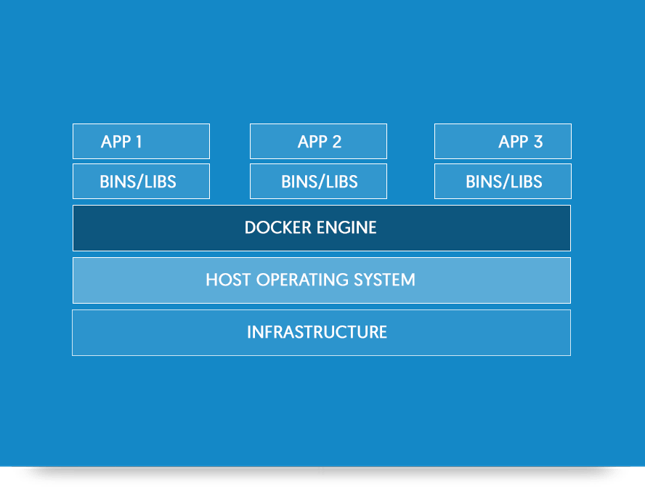
Docker Containers vs. Virtual Machines

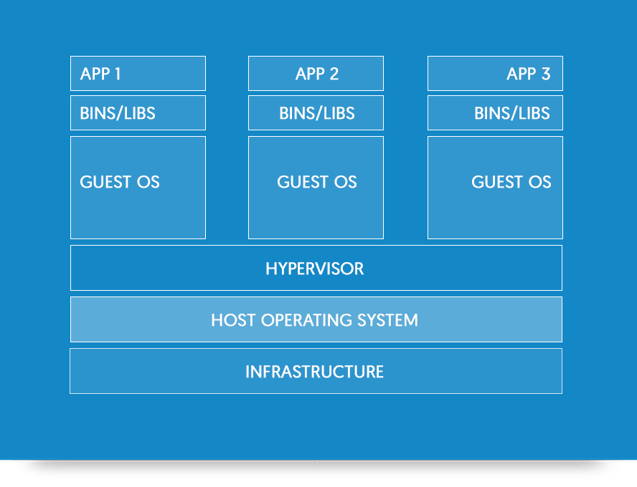
  • Docker container can be created/destroyed very quickly as compare to the virtual machines.
  • Docker containers are light weight is compare to the virtual machines. Being lightweight more containers can run at some time on a host.
  • Docker container make use of resources very efficiently. In case of virtual machines capacity is need to be reserved (compute + storage), whereas this is not needed is case of Docker containers.
  • Virtual Machines can be migrated across servers when they are running, but Docker need to stopped before migration as there is no hypervisor layer.


*Images taken from Docker Documentations


Docker Terminologies

  • Images – Images are templates for the docker containers.
  • Containers – created from Docker images and run the actual application.
  • Docker Daemon – The background service running on the host that manages building, running the containers.

Prerequisites Docker Installation

  1. CentOS 7 64 Bit / Kernel 3.10.x kernel in the minimum required.
  2. Disabled the SELinux and FirewallD services:  # systemctl stop firewalld
  3. Install EPEL repository:    # yum install -y epel-release

 Install Docker via yum provided by CentOS (method 1)

# yum install -y docker


Install Docker CE (community edition)  Software (method 2)

First remove older version of docker (if any):

# yum remove docker docker-client docker-common docker-selinux docker-engine-selinux docker-engine docker-ce

Next install needed packages:

# yum install yum-utils device-mapper-persistent-data lvm2 -y

Configure the docker-ce repo:

# yum-config-manager --add-repo https://download.docker.com/linux/centos/docker-ce.repo

Finally install docker-ce:

# yum install docker-ce -y


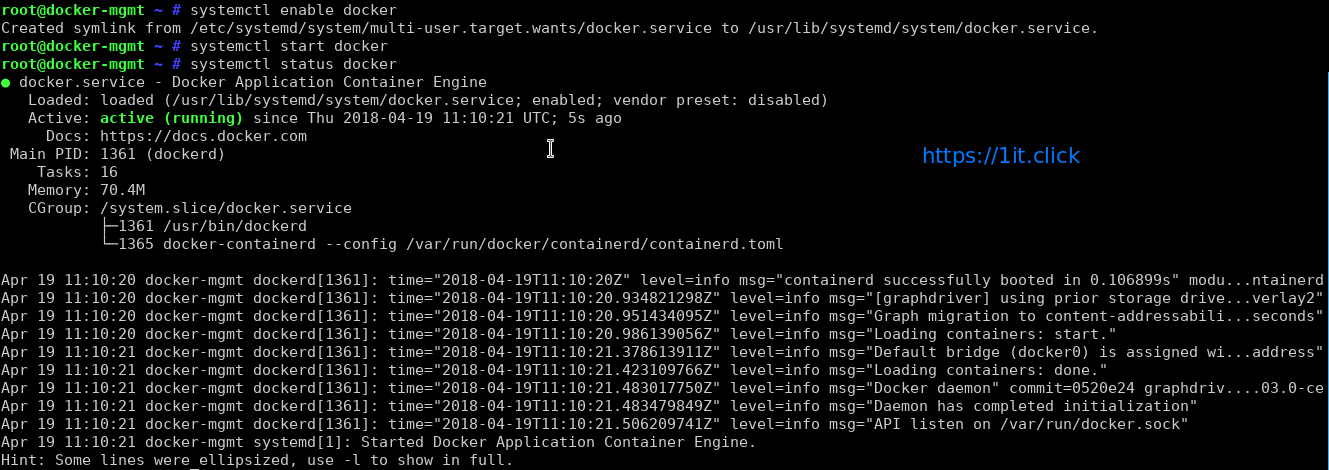
Enable and Start Docker service

# systemctl enable docker
# systemctl start docker


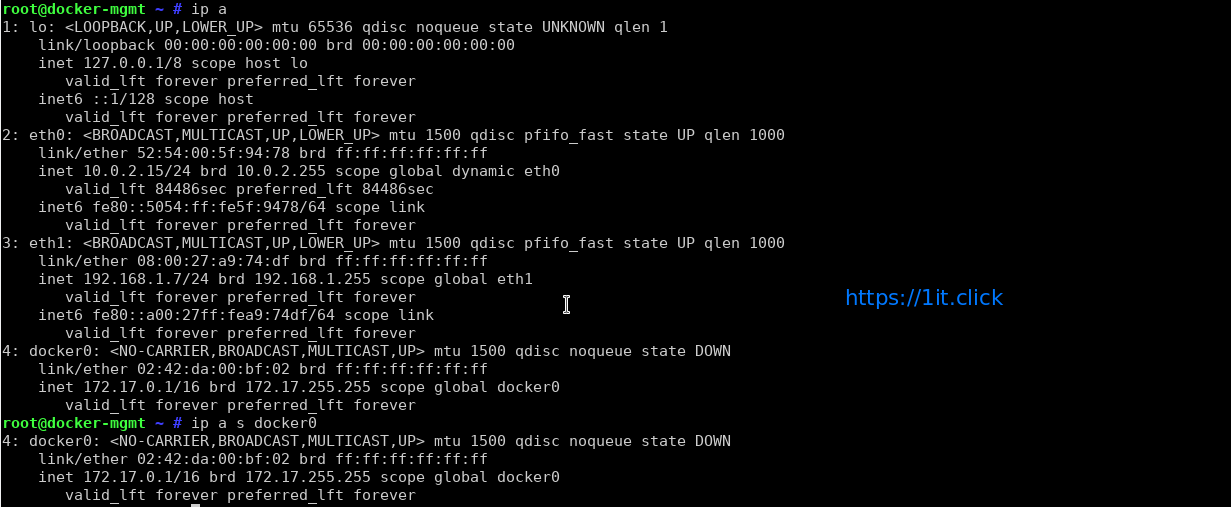
How to find out info about Docker network bridge and IP addresses

Default network bridge named as docker0 and is assigned with an IP address. To find this info run the following:

# ip a

# ip a s docker0


How to run docker commands

The syntax is:

# docker command
# docker command arg
# docker [options] command arg
# docker help | more


Getting help

# docker help | more

Run ‘docker COMMAND --help‘ for more information on a command:

# docker ps --help
# docker cp --help


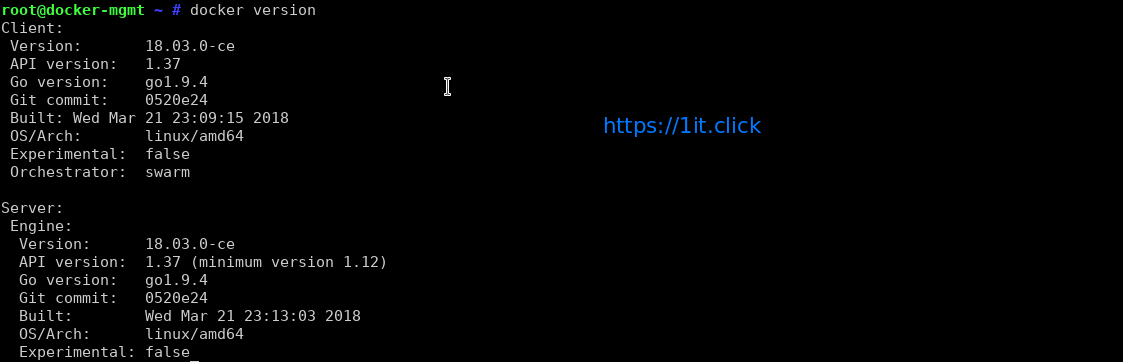
Check the Docker version

# docker version


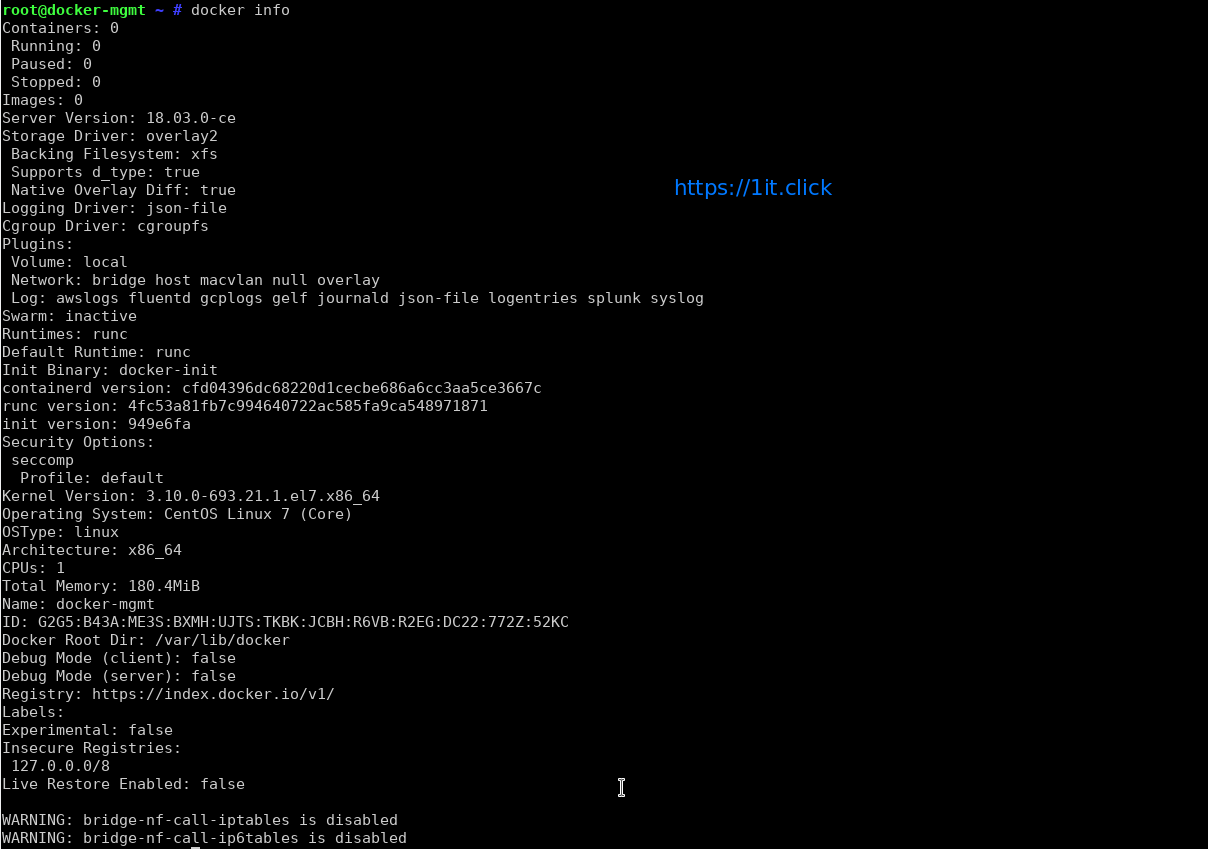
Check Detailed Docker Information

# docker info


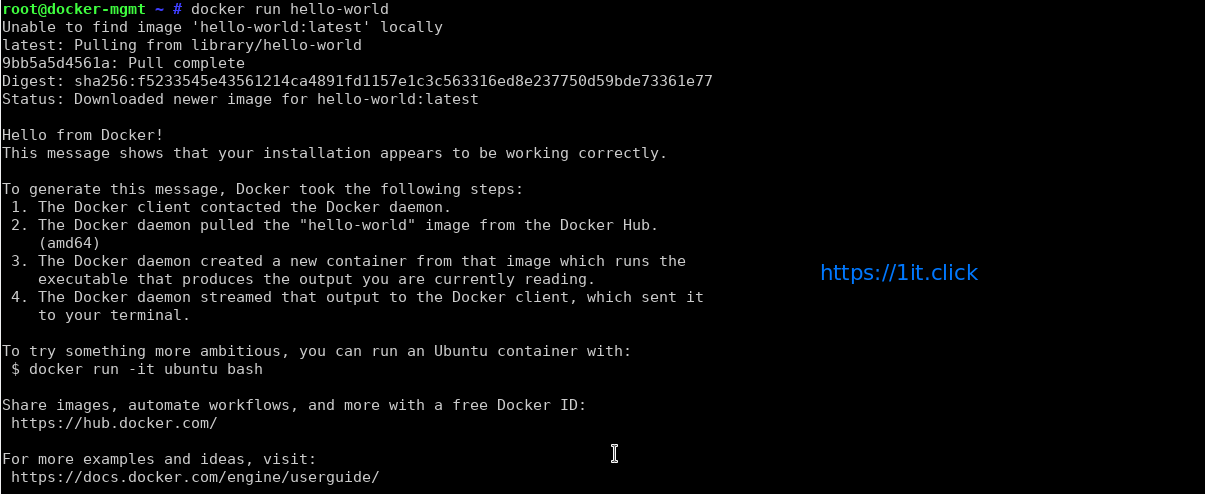
How to test your docker installation

Docker images are pulled from docker cloud/hub such as docker.io or registry.access.redhat.com and so on. Type the following command to verify that your installation working:

# docker run hello-world


Search Docker Images on Internet

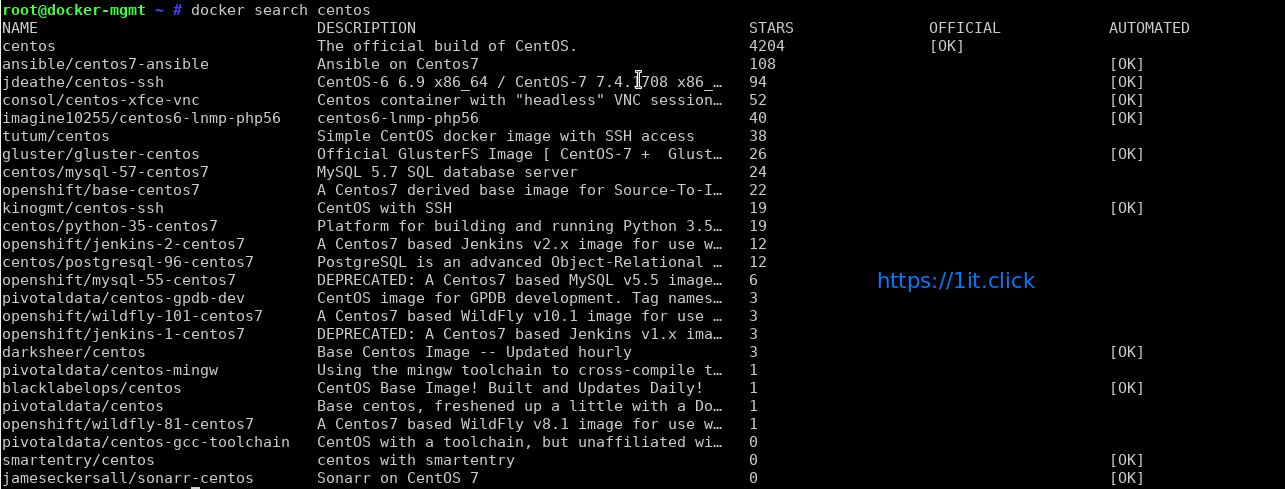
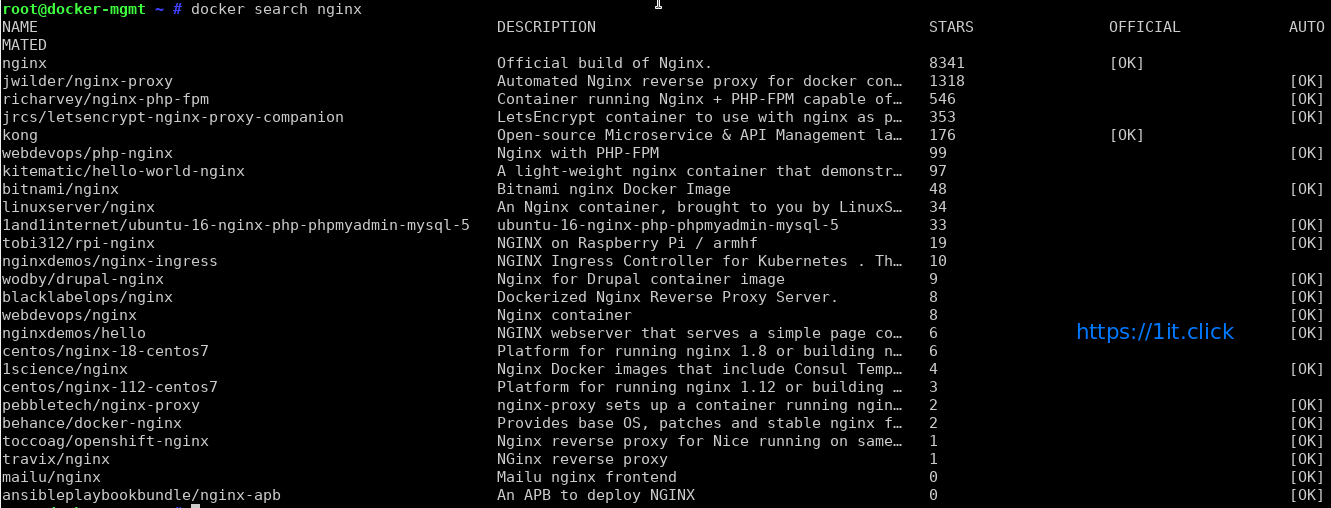
Now you have working Docker setup. It is time to find out images. We can find images for all sort of open source projects and Linux distributions. To search the Docker Hub/cloud for centos or nginx image run:

# docker search centos


# docker search nginx


Download Docker Images

To pull an image named centos or nginx from a registry, run:

# docker pull centos:centos7

# docker pull nginx


To Display the list of locally available images

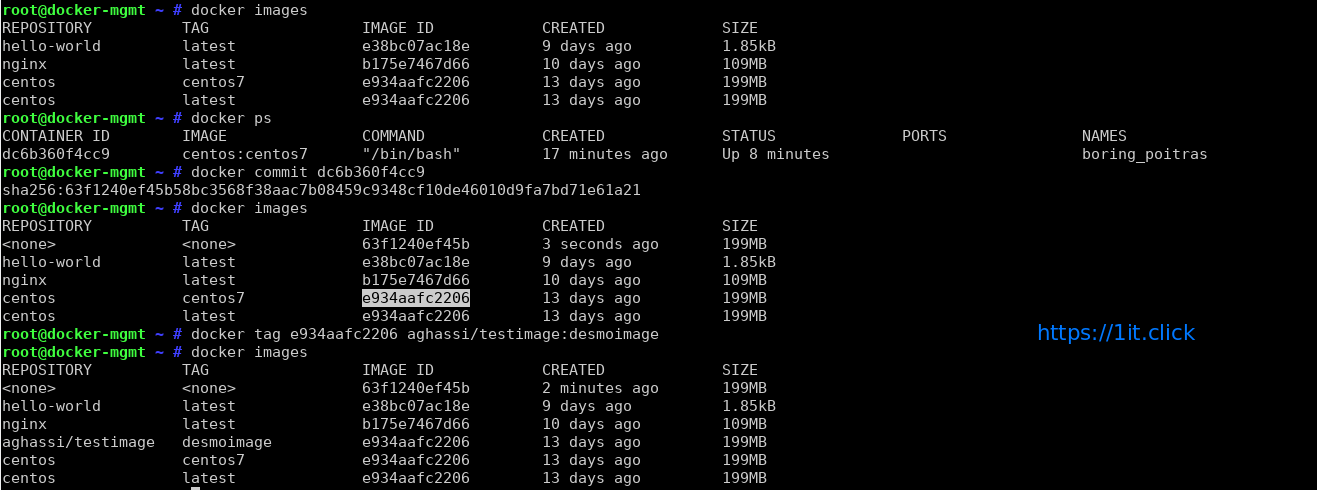
# docker images


TAG − This is used to logically tag images.
Image ID − This is used to uniquely identify the image.
Created − The number of days since the image was created.
Virtual Size − The size of the image. 


Remove Docker Image

When you have lots of running which are obsolete or you no longer need any Docker image then you can remove that image using the following command.

# docker rmi [IMAGEname]


To test your new image

The concept is little catchy, whenever a command is sent for execution in the Docker image, a container in obtained. When this command execution is finished, the container gets stopped (a non-running or exited container state). It Means at every command execution into the same image a new container is created again and again and exited.

# docker run centos:centos7 /bin/ping 1it.click -c 5


List Docker Containers

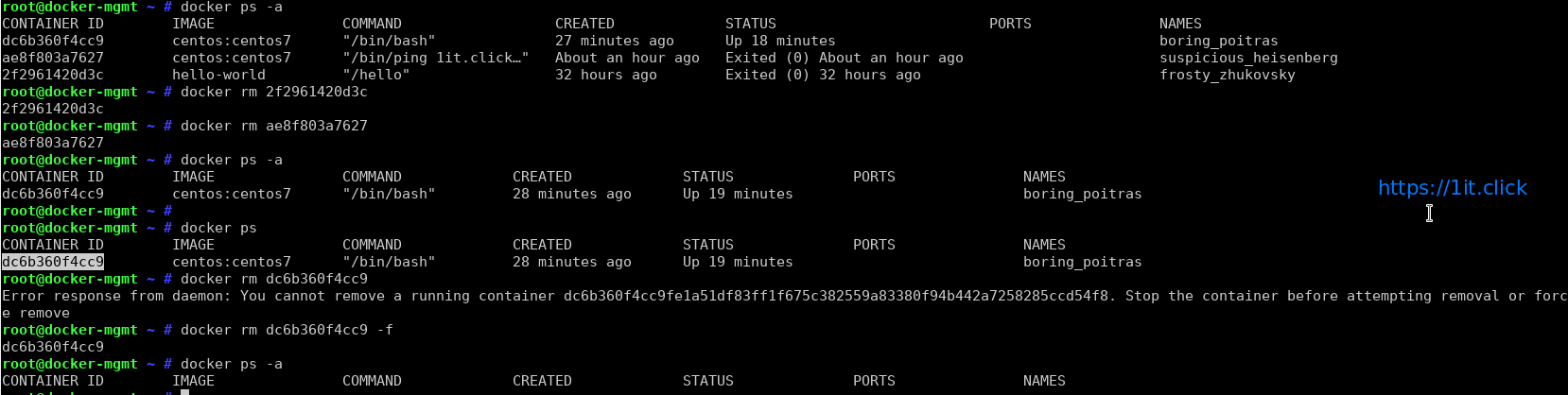
Whenever a command execution is performed on a Docker Image a container is created and gets stopped after execution but it remains in exited or non-running state. The following command will display a list of the running and stopped (non-running) containers:

# docker ps -l

In a production environment there are many running containers and to list them we have command. This command is used to get the currently running containers:

# docker ps

This Can also be used with -a argument and this command will list all of the containers on the system:

# docker ps -a


Checking Docker Networking

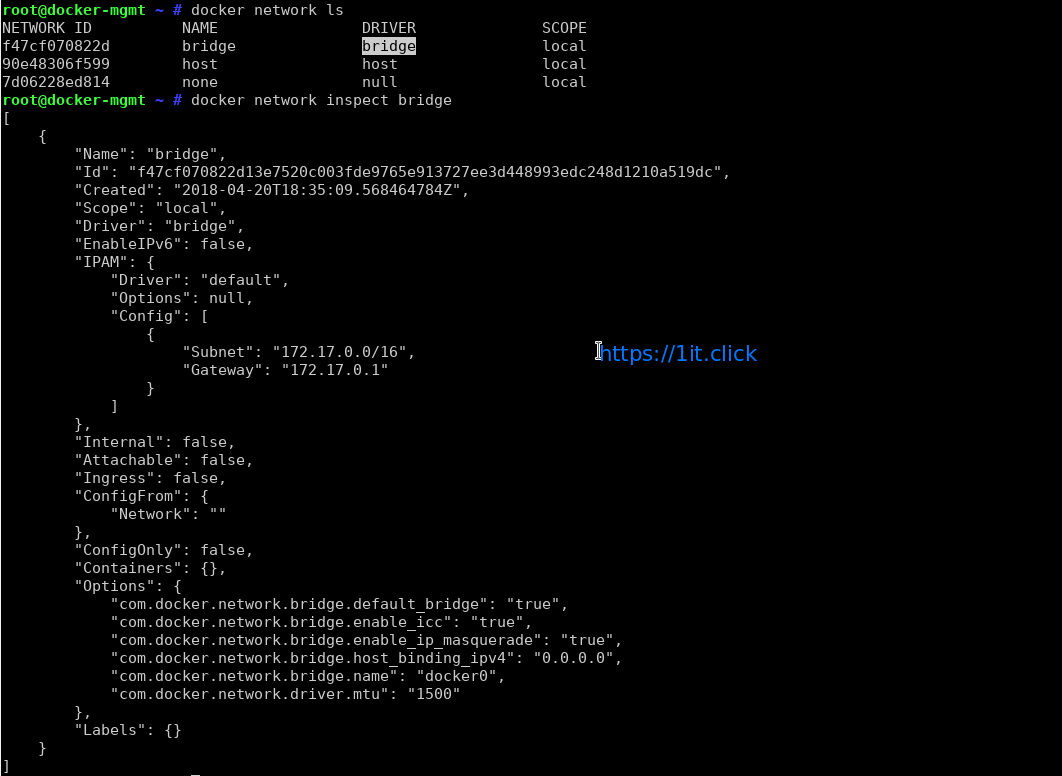
# docker network ls

# docker network inspact [network name]


Checking Resource Consumption by Running Container

# docker stats


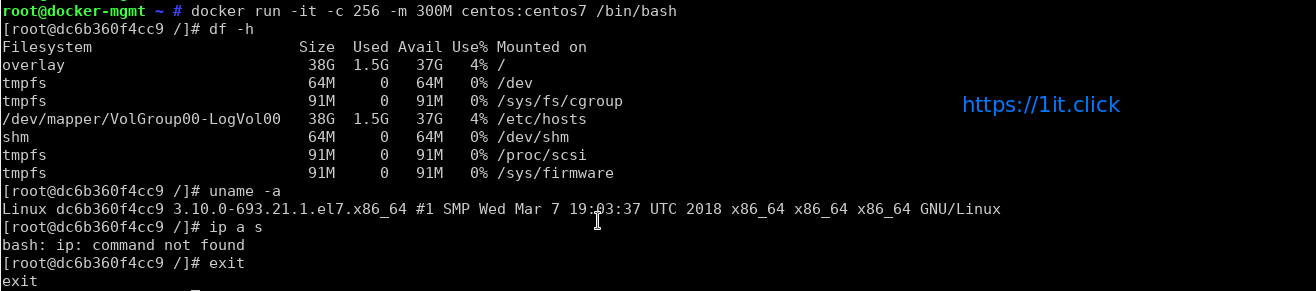
Check Resource limits for a docker container

# docker run -it -c 256 -m 300M centos:centos7 /bin/bash


Stop/Start/Restart operation

# docker start [container ID]                ## to start a docker container

# docker stop [container ID]                 ## to stop a docker container

# docker restart [container ID]              ## to restart a docker container


Committing the Docker Container Updates (This command turns your container to an image) And Adding a Repository/Tag value to a image

# docker commit [container ID]

# docker tag [image ID] <repo : tags>

Removing/Deleting a container

# docker rm [container ID]


Checking the docker container Logs

# docker logs [container ID]


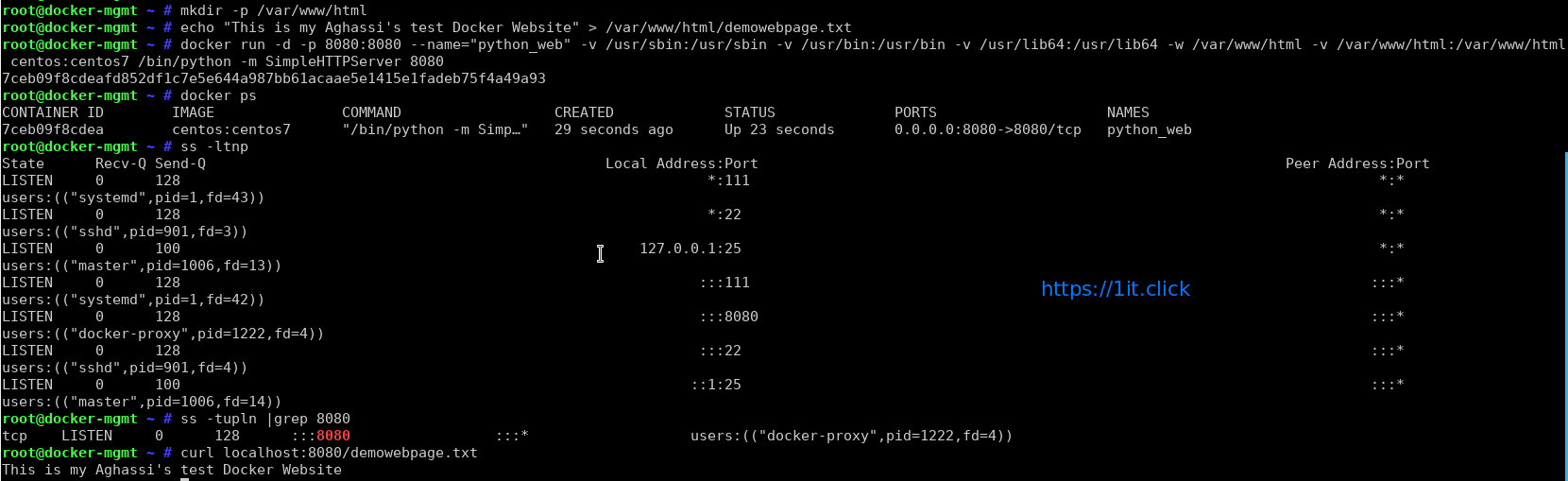
Lets create our container and hots a demo website quickly using Python Simple HTTP Server module quickly will listen on port 8080:

# mkdir -p /var/www/html

# echo "This is my Aghassi's test Docker Website" > /var/www/html/demowebpage.txt

# docker run -d -p 8080:8080 --name="python_web" -v /usr/sbin:/usr/sbin -v /usr/bin:/usr/bin -v /usr/lib64:/usr/lib64 -w /var/www/html -v /var/www/html:/var/www/html centos:centos7 /bin/python -m SimpleHTTPServer 8080

-d, –detach                             Run container in background and print container ID

-p, –publish list                     Publish a container’s port(s) to the host (default [])

-v, –volume list                     Bind mount a volume (default [])

-w, –workdir string              Working directory inside the container

Check the network ports allocation:

# ss -tupln |grep 8080

Lets test the website:

# curl localhost:8080/demowebpage.txt


How to run Docker nginx image

Now you pulled nginx image, it is time to run it:

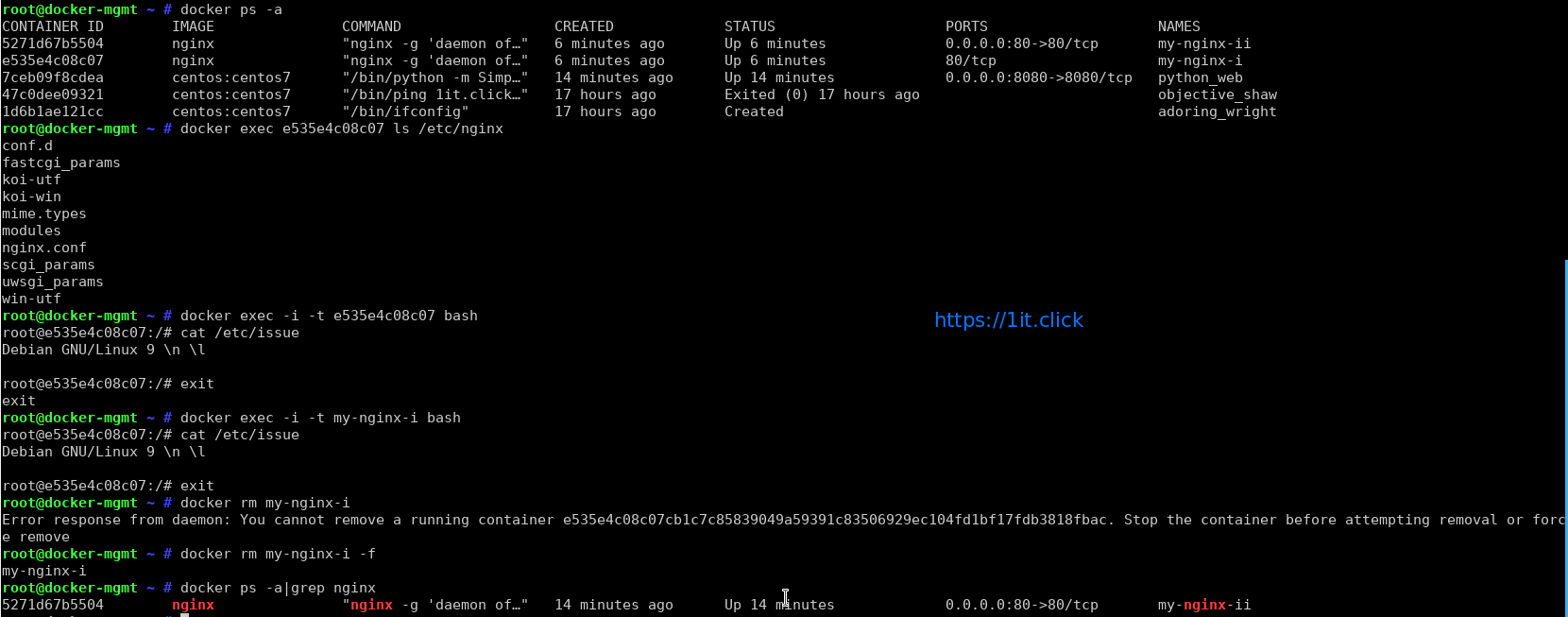
# docker run --name my-nginx-i --detach nginx

Say you want to host simple static file hosted in /var/www/html/ using nginx container:

# docker run --name my-nginx-ii -p 80:80 -v /var/www/html/:/usr/share/nginx/html:ro -d nginx

Where,

–name my-nginx-i : Assign a name to the container
–detach : Run container in background and print container ID
-v /var/www/html/:/usr/share/nginx/html:ro : Bind mount a volume
-p 80:80 : Publish a container’s port(s) to the host i.e redirect all traffic coming to port 80 to container traffic

Go ahead and create a file named index.html in /var/www/html/:

# echo 'Welcome. I am Nginx server locked inside Docker' > /var/www/html/index.html

Test it:

curl http://your-host-ip-address/
curl 192.168.1.7

Sample outputs:

Welcome. I am Nginx server locked inside Docker

How to run a command in a running container

Run ls /etc/nginx command for my-nginx-i container

# docker exec e535e4c08c07 ls /etc/nginx

OR

# docker exec my-nginx-i ls /etc/nginx

Want to gain bash shell for a running container and make changes to nginx image?

# docker exec -i -t e535e4c08c07 bash

OR

# docker exec -i -t my-nginx-i bash


How To Use netstat


Introduction

netstat (network statistics) is a command line tool for monitoring network connections both incoming and outgoing as well as viewing routing tables, interface statistics etc. netstat is available on all Unix-like Operating Systems and also available on Windows OS as well. It is very useful in terms of network troubleshooting and performance measurement. netstat is one of the most basic network service debugging tools, telling you what ports are open and whether any programs are listening on ports.


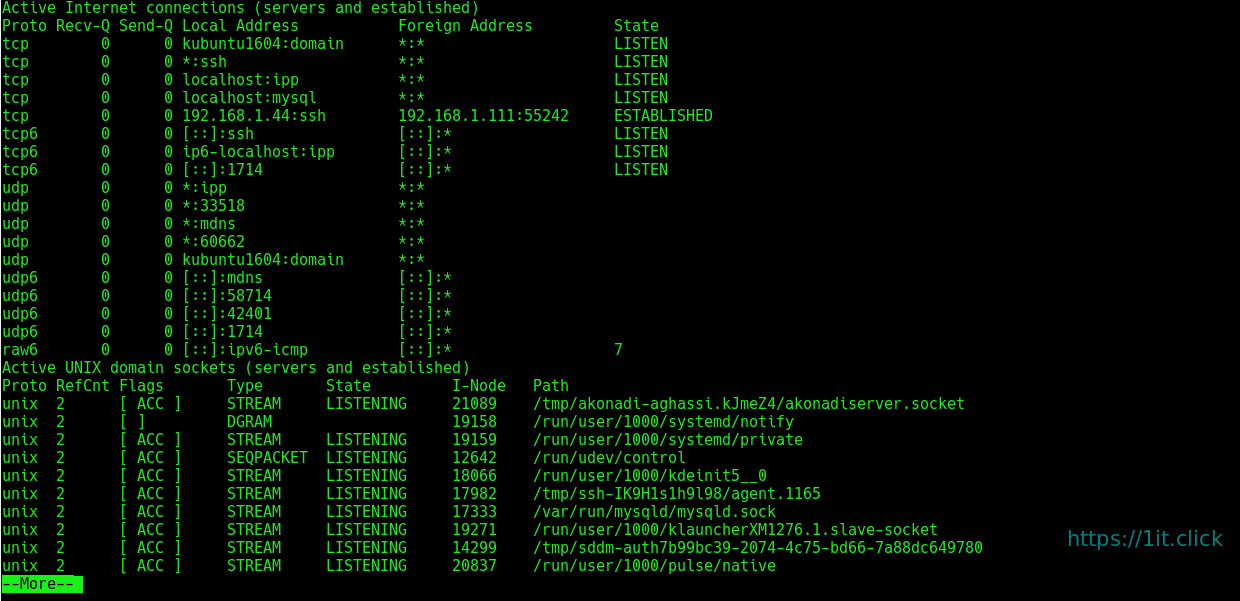
Listing all the LISTENING Ports of TCP and UDP connections

$ netstat -a | more


Listing TCP Ports connections

Listing only TCP (Transmission Control Protocol) port connections:

$ netstat -at


Listing UDP Ports connections

Listing only UDPUser Datagram Protocol ) port connections:

$ netstat -au


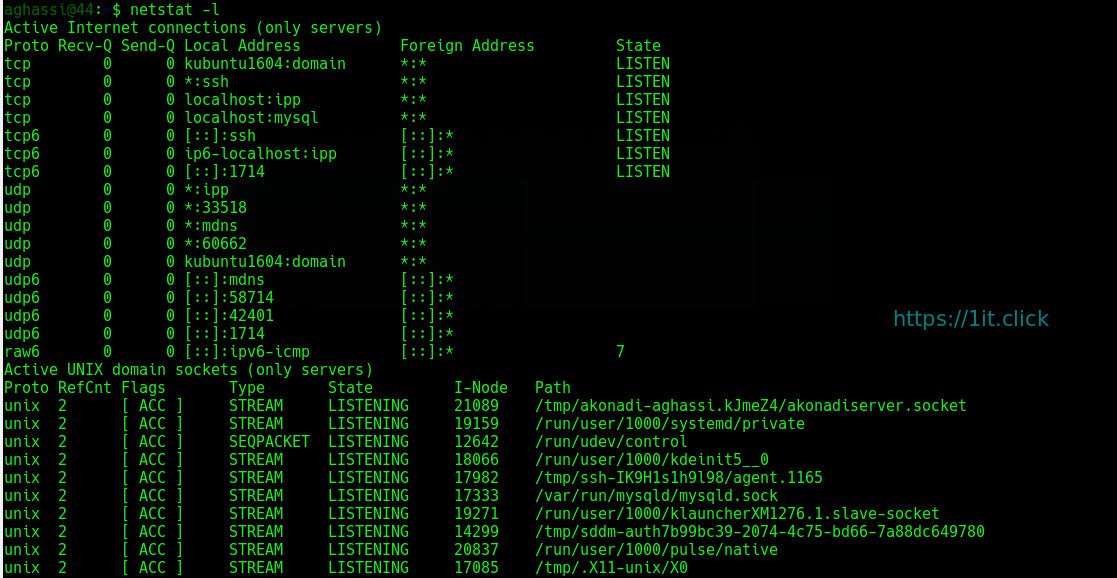
Listing All LISTENING Connections

Listing all active listening ports connections:

$ netstat -l

Listing All TCP Listening Ports

Listing all active listening TCP ports:

$ netstat -lt


Listing All UDP Listening Ports

Listing all active listening UDP ports:

$ netstat -lu


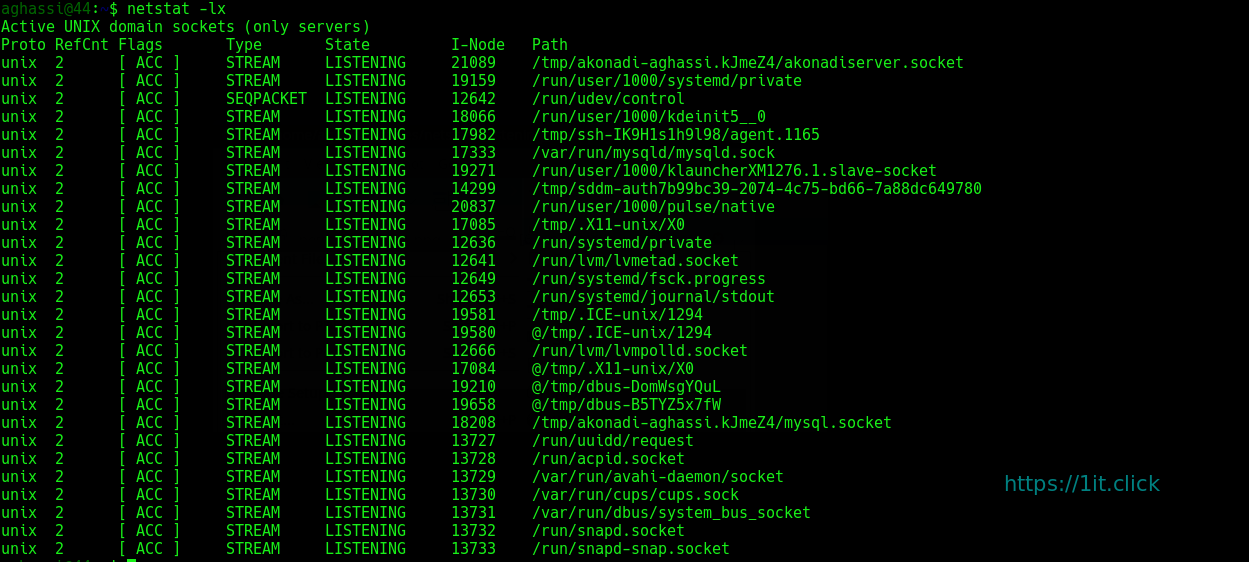
Listing all UNIX Listening Ports

Listing all active UNIX listening ports:

$ netstat -lx


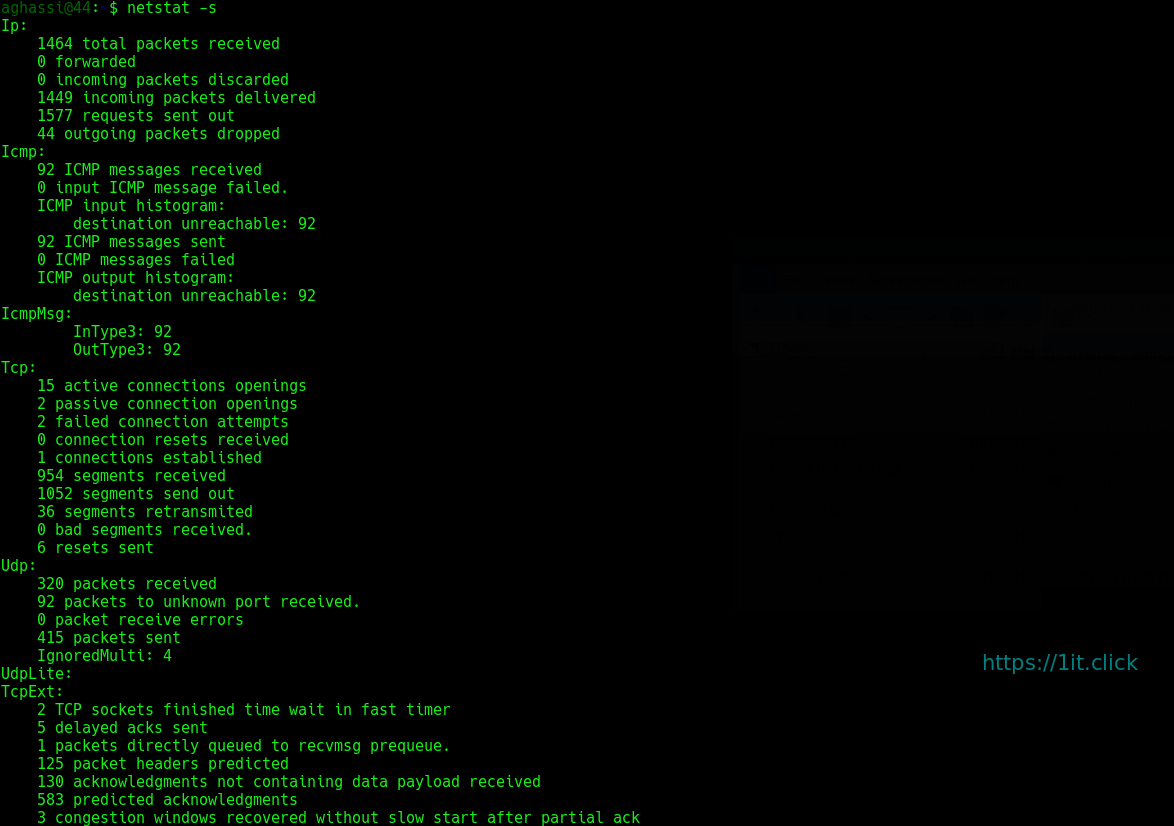
Showing Statistics by Protocol

Displays statistics by protocol. By default, statistics are shown for the TCP, UDP, ICMP, and IP protocols. The -s parameter can be used to specify a set of protocols:

$ netstat -s


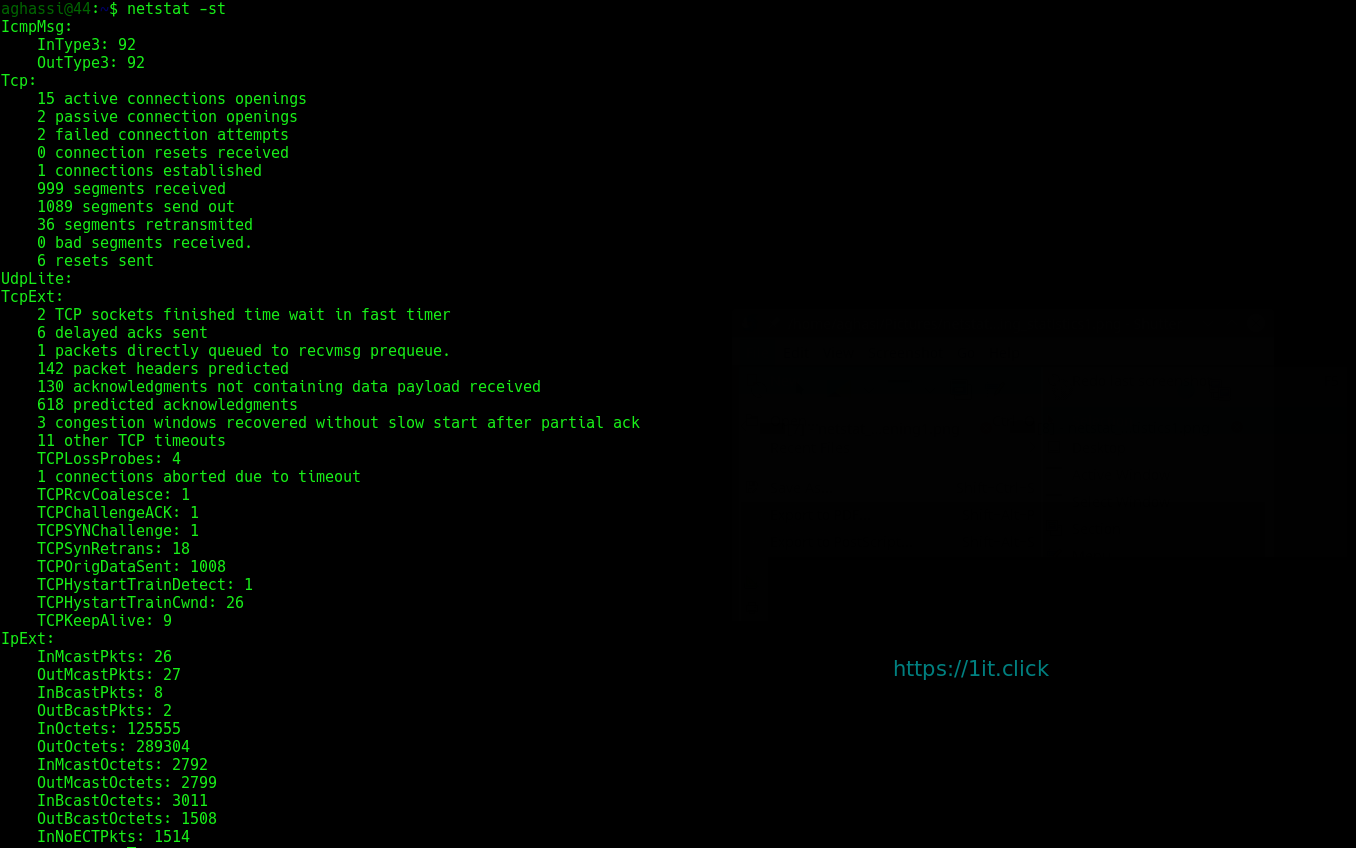
Showing Statistics by TCP Protocol

Showing statistics of only TCP protocol:

$ netstat -st


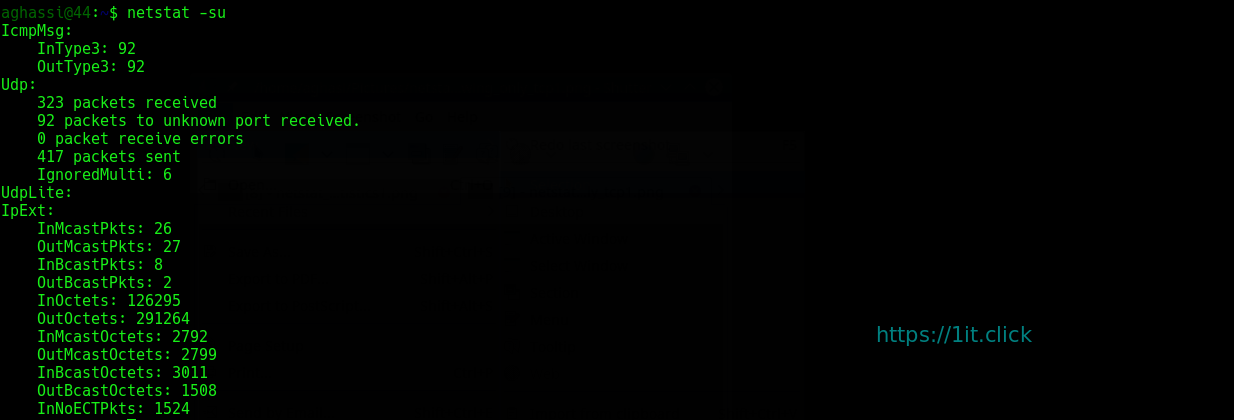
Showing Statistics by UDP Protocol

Showing statistics of only UDP protocol:

$ netstat -su


Displaying Service name with PID

Displaying service name with their “PID/Program Name”:

$ netstat -tp


Displaying Promiscuous Mode

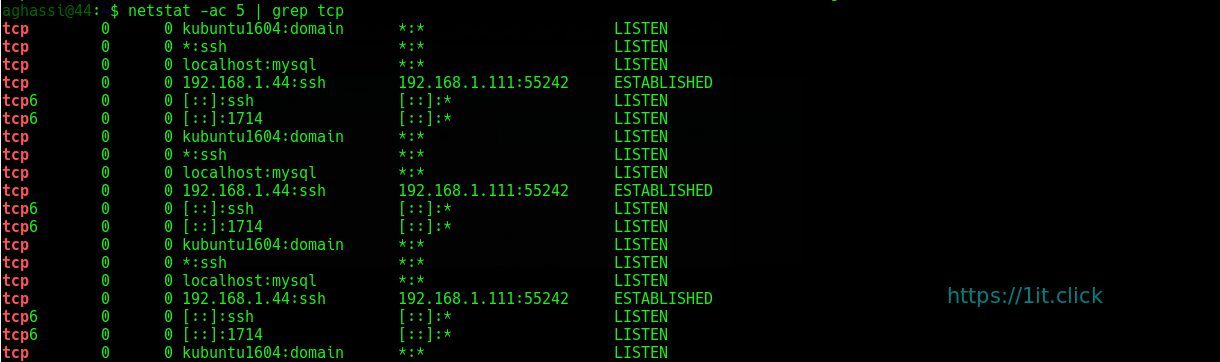
Displaying Promiscuous mode with -ac switch, netstat print the selected information or refresh screen every five second. Default screen refresh in every second.

$ netstat -ac 5 | grep tcp


Displaying Kernel IP routing

Display Kernel IP routing table with netstat and route command:

$ netstat -r


Showing Network Interface Transactions

Showing network interface packet transactions including both transferring and receiving packets with MTU size:

$ netstat -i


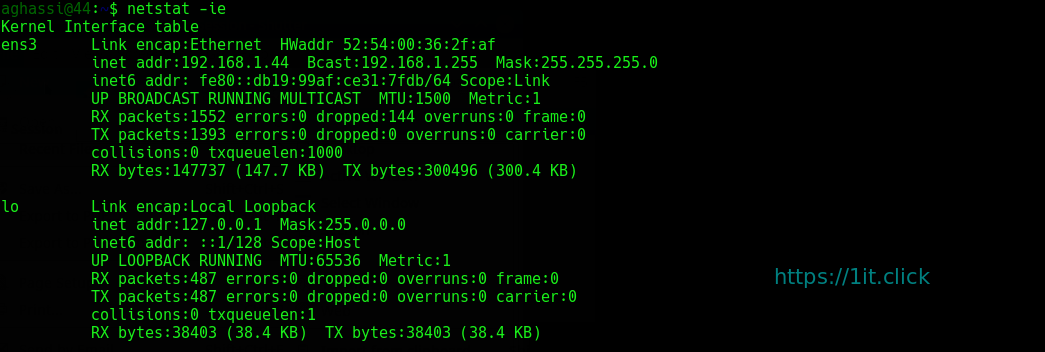
Showing Kernel Interface Table

Showing Kernel interface table, similar to ifconfig command:

$ netstat -ie


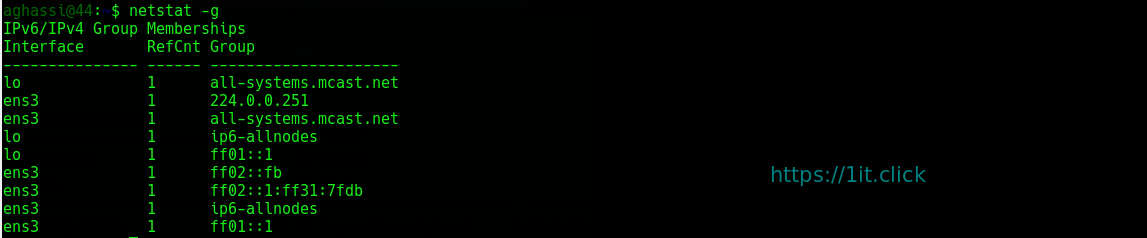
Displaying IPv4 and IPv6 Information

Displays multicast group membership information for both IPv4 and IPv6:

$ netstat -g


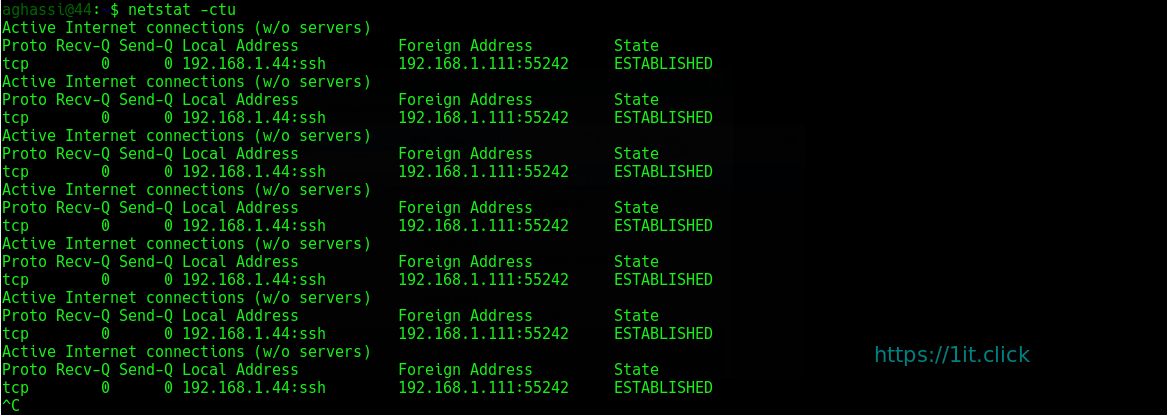
Print netstat Information Continuously

To get netstat information every few second, then use the following command, it will print netstat information continuously, say every few seconds

$ netstat -c


Finding Non Supportive Address

Finding un-configured address families with some useful information:

$ netstat --verbose


Finding Listening Programs

Find out how many listening programs running on a port:

$ sudo netstat -ap | grep ssh


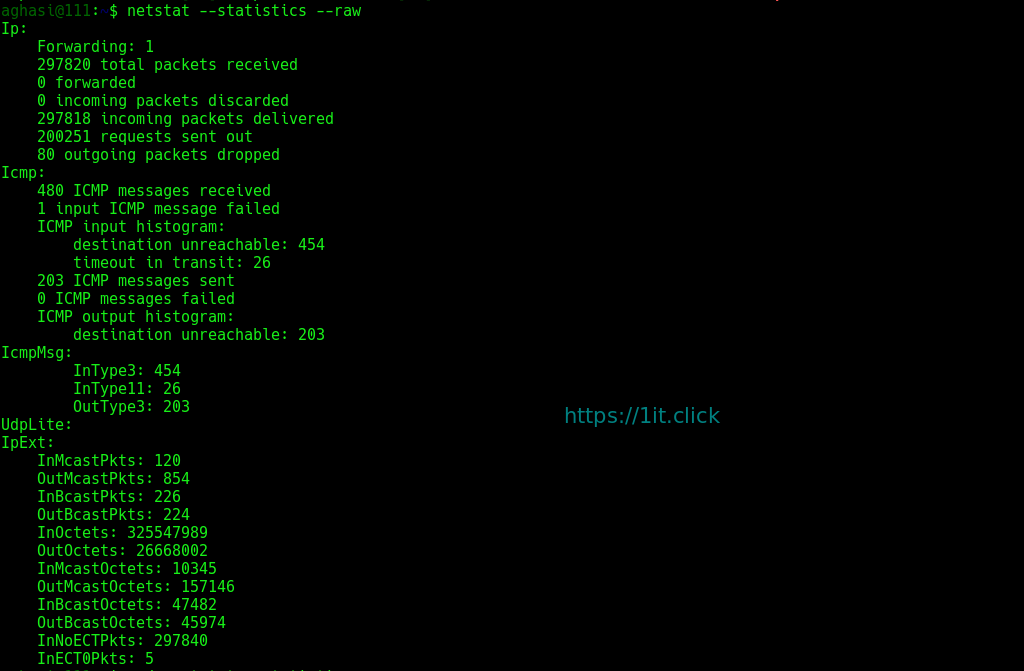
Displaying RAW Network Statistics

$ netstat --statistics --raw

How To Use smartctl


Introduction

The step by step command example below show the process of using SMART disk monitoring tool that provide us with the information of overall hard disk health status. The SMART it self stand for Self Monitoring Analysis and Reporting Tool and on Linux, the smartctl command is use to display and manipulate SMART. The step by step example below show how to use smartctl command to enable SMART and disable SMART on the hard disk drives and the example below also show the use the smartctl command to get hard disk drive health status.


Installation

On Ubuntu use apt:

$ sudo apt install smartmontools

On CentOS, use yum:

$ sudo  yum install smartmontools


Enabling SMART Monitoring Tools on Hard Disk Devices (turn on SMART)

To enable SMART on hard disk drive, the example below show that the SMART is enable (turn to ON status) on the /dev/sdc :

$ sudo smartctl -s on /dev/sdc

Verify the SMART status turn to Enable (on) for the disk device:

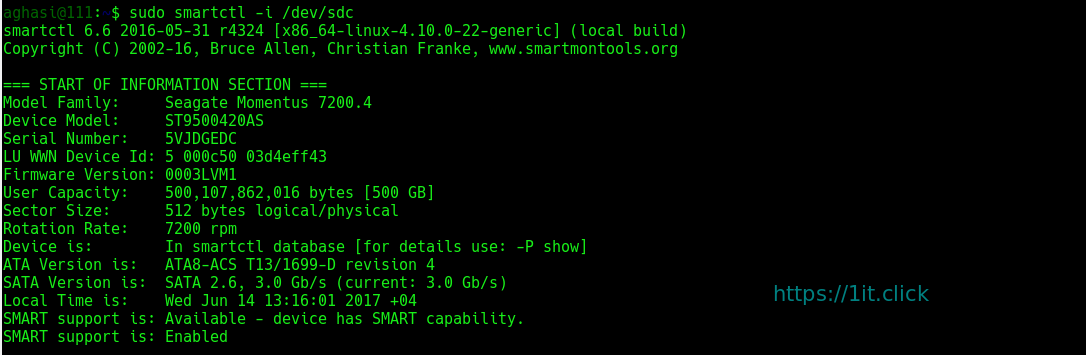
$ sudo smartctl -i /dev/sdc

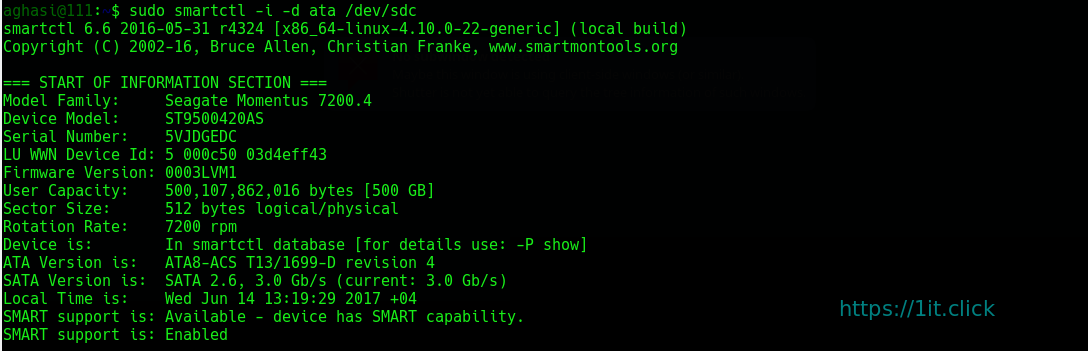
Test if your disk has SMART support:

$ sudo smartctl -i -d ata /dev/sdc

Note: The command example below show another example of smartctl command that can be use to enable SMART monitoring tool on the disk device:

$ sudo smartctl --smart=on --offlineauto=on --saveauto=on /dev/sdc


Disable SMART Monitoring Tools on Hard Disk Devices (turn off SMART)

To disable the SMART monitoring tool for the disk device:

$ sudo smartctl -s off /dev/sdc

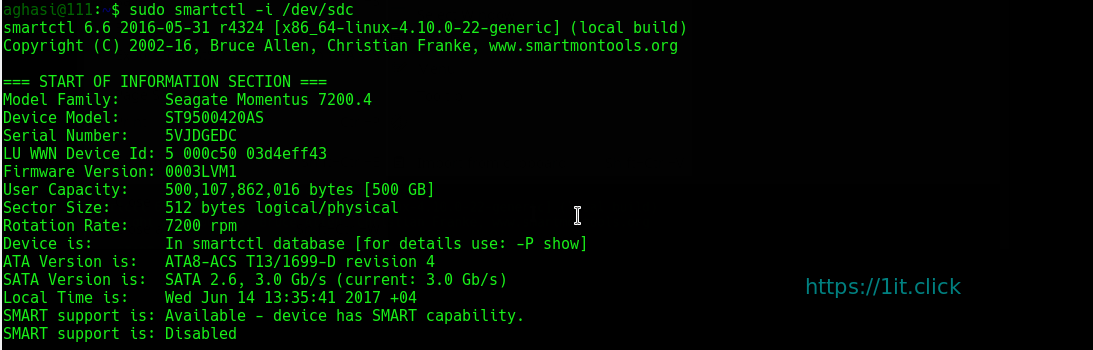
To verify the changes made:

$ sudo smartctl -i /dev/sdc


Get Hard Disk Device SMART Health Status

The smart command example below show the information on the hard disk device health status for /dev/sdc device. {if you get FAILED, you should start backing up your data and browsing adds for a new hard drive. }

$ sudo  smartctl -H /dev/sdc


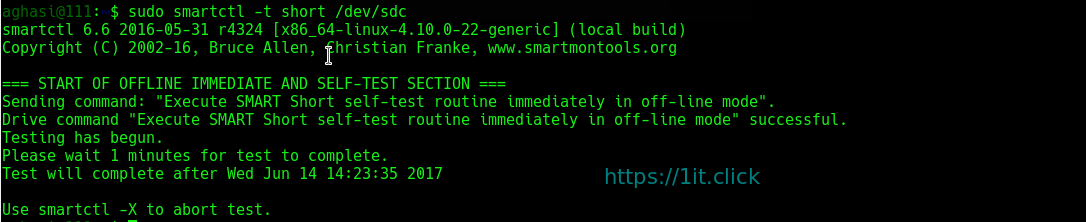
To run short test on your hard disk

$ sudo smartctl -t short /dev/sdc


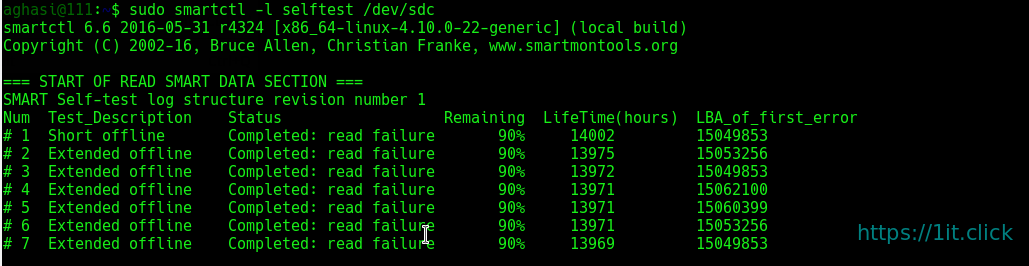
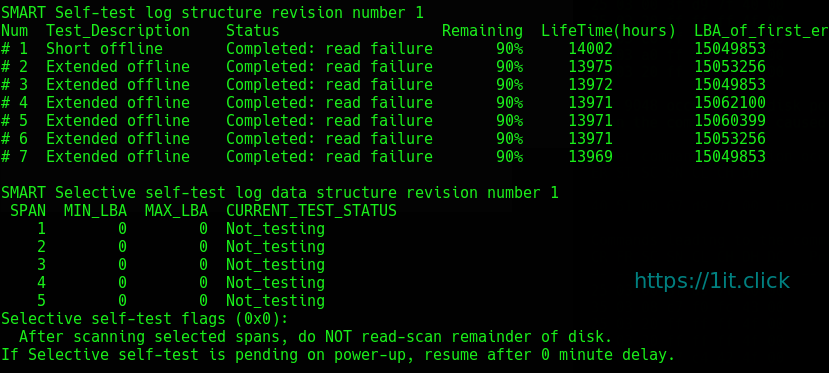
To see the selftest logs of smartctl

$ sudo smartctl -l selftest /dev/sdc


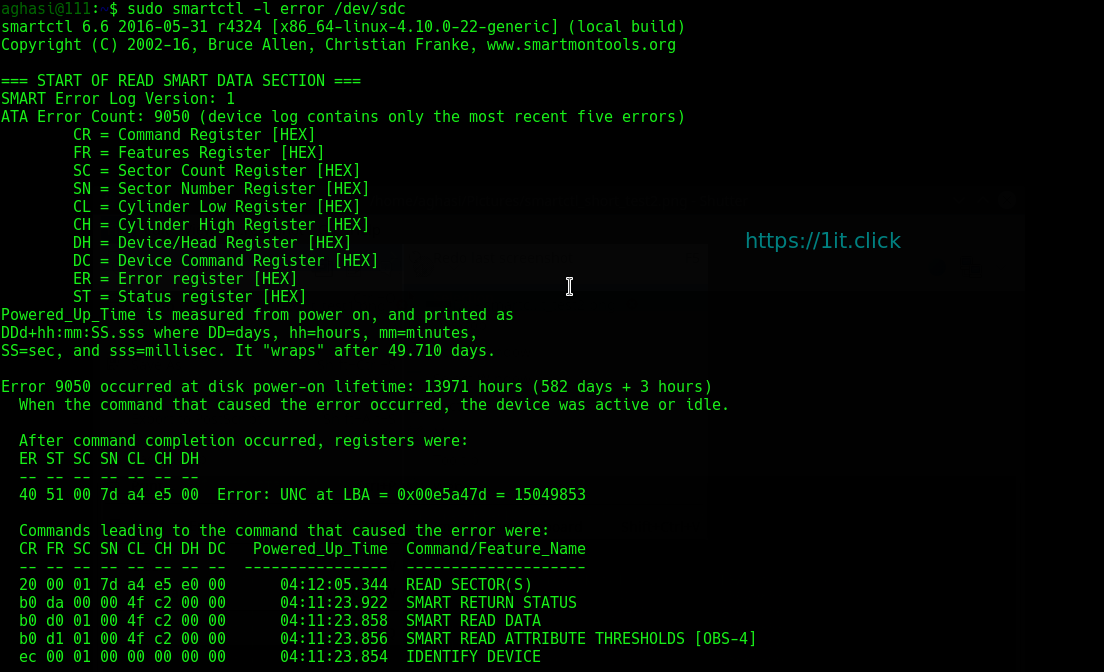
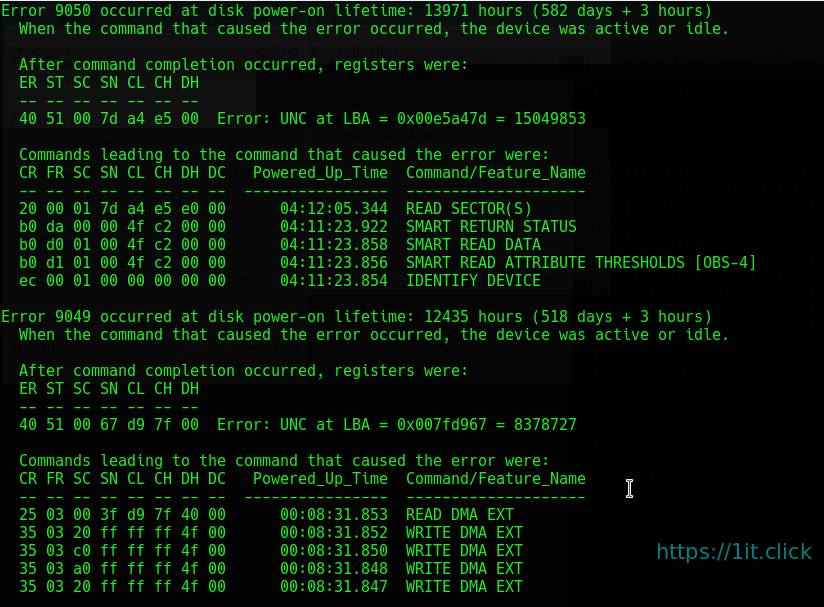
To check past problems of your drive

$ sudo smartctl -l error /dev/sdc

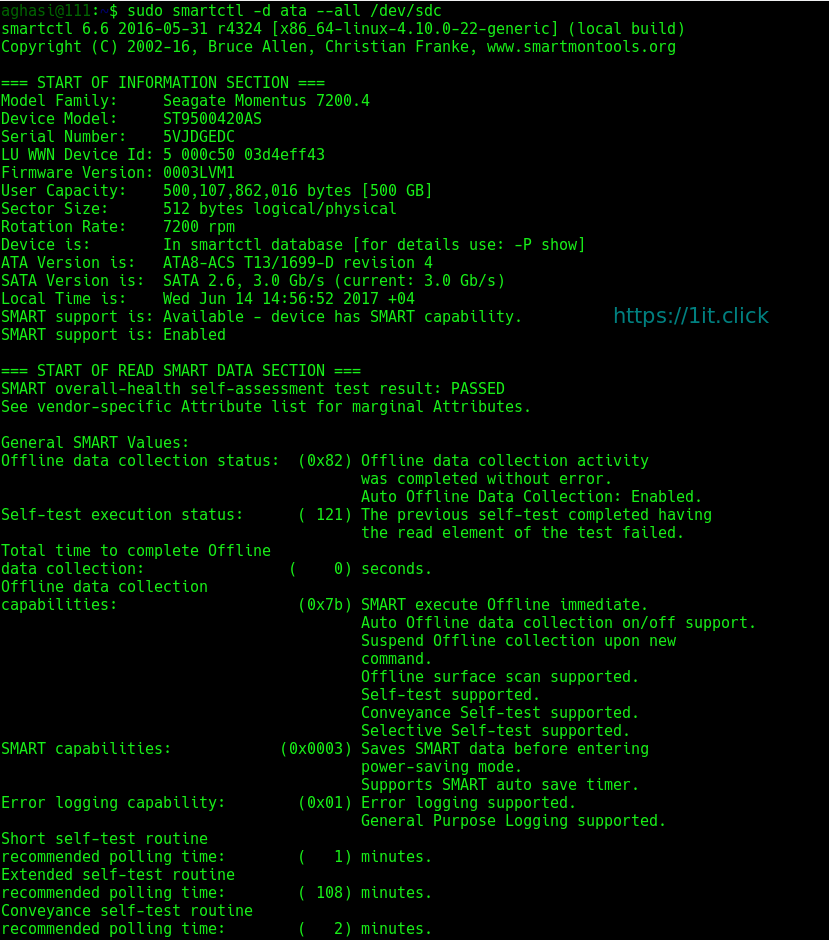
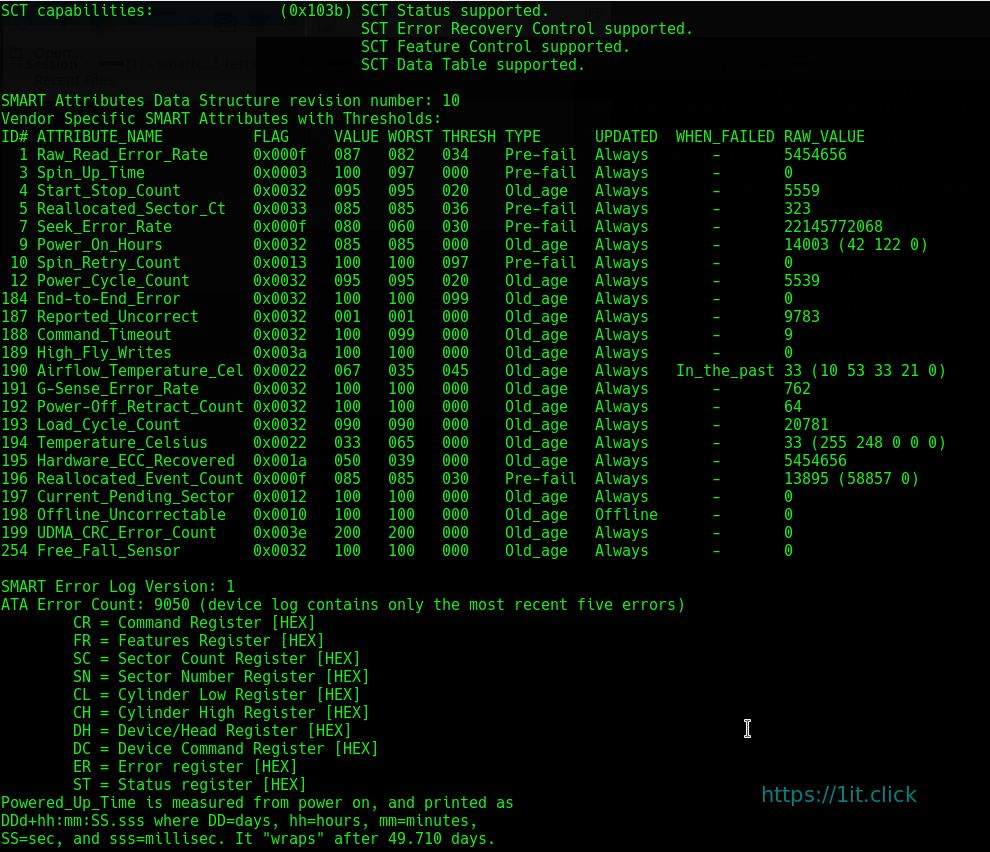
$ sudo smartctl -d ata --all /dev/sdc

$ sudo smartctl -a /dev/sdc | grep -i reallocated

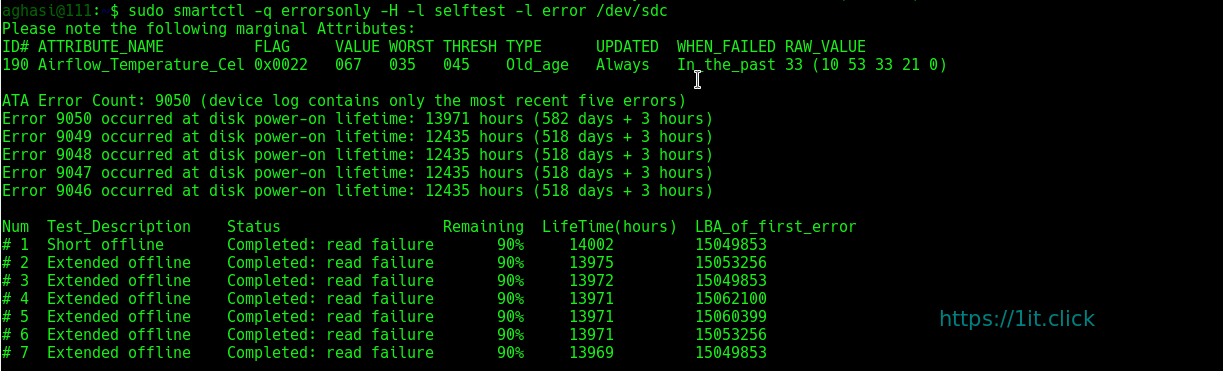
The 323 > 0 means that everything is NOT OK, then you should think about the replacement.

$ sudo smartctl -q errorsonly -H -l selftest -l error /dev/sdc


Nagios Alerts Via Pushover


I came across Pushover recently which makes it easy to send real-time notifications to your Android and iOS devices. And easy it is. It also allows you to set up applications with logos so that you can have multiple Nagios installations shunting alerts to you via Pushover with each one easily identifiable. After just a day playing with this, it’s much nicer than SMS’.

So, to set up Pushover with Nagios, first register for a free Pushover account. Then create a new application for your Nagios instance. I set the type to Script and also upload a logo. After this, you will be armed with two crucial pieces of information: your application API tokan/key ($APP_KEY) and your user key ($USER_KEY).

To get the notification script, clone this GitHub repository or just down this file – notify-by-pushover.php.

You can test this immediately with:

$ echo "Test message" | ./notify-by-pushover.php HOST $APP_KEY $USER_KEY RECOVERY OK

The parameters are:

USAGE: notify-by-pushover.php  $APP_KEY $USER_KEY NOTIFICATIONTYPE

Now, set up the new notifications in Nagios commands.cfg:

# 'notify-by-pushover-service' command definition
define command{
   command_name notify-by-pushover-service
   command_line /usr/bin/printf "%b" "$NOTIFICATIONTYPE$: \
       $SERVICEDESC$@$HOSTNAME$: $SERVICESTATE$ ($SERVICEOUTPUT$)" |                            \
     /usr/local/nagios/plugins/notify-by-pushover.php \
       SERVICE $APP_KEY $CONTACTADDRESS1$           \
       $NOTIFICATIONTYPE$ $SERVICESTATE$
}

# 'notify-by-pushover-host' command definition
define command{
 command_name notify-by-pushover-host
 command_line /usr/bin/printf "%b" "Host '$HOSTALIAS$'    \
       is $HOSTSTATE$: $HOSTOUTPUT$" |                    \
     /usr/local/nagios-plugins/notify-by-pushover.php \
       HOST $APP_KEY $CONTACTADDRESS1$ $NOTIFICATIONTYPE$ \
       $HOSTSTATE$
}

Then, in your contact definition(s) add/update as follows:

define contact{
 contact_name ...
 ...
 service_notification_commands ...,notify-by-pushover-service
 host_notification_commands ...,notify-by-pushover-host
 address1 $USER_KEY
}

Make sure you break something to test that this works!

Logging With Journald In CentOS7


Introduction

CentOS 7 comes with services which saves logging information. Some services write their own logs directly to their log information files, e.g. apache maintain their own logs. Some of the service maintain their logs through systemctl. Systemctl is a services that take care of starting, stopping or monitoring the status of a process. systemctl further communicates to journald which keep track on log information. journalctl is used to grep log information from journald.

rsyslog is the classical logging method. You may ask either we should use journalctl or rsyslog to maintain our logging information. We can integrate both rsyslog ans journald. The rsyslog messages will be sent to journald or vice versa. The facility is not enabled by default.


Definition of Journal

Journal is a component of systemd. It capture log messages of kernel logs, syslog messages, or error log messages. It collect them, index them and makes available to the users. Journal are stored in /run/log/journal directory.


Lets have a look on current log database:

When used alone, every journal entry that is in the system will be displayed within a pager (usually less) for you to browse. The oldest entries will be up top:

$ sudo journalctl

You will likely have pages and pages of data to scroll through, which can be tens or hundreds of thousands of lines long if systemd has been on your system for a long while. But, there are some remarkable difference, in journalctl lines having notices or waning will be bold, time-stamps are your local time zone, after every boot a new line will be added to clarify that new log begins from now, errors will be highlighted red.


See log message of current boot only

$ sudo journalctl -b


Let us see some error messages

$ sudo journalctl -p err

To have last 10 events that happen, type

$ sudo journalctl -f


See how must disk space is occupied by journal

$ sudo journalctl --disk-usage
Archived and active journals take up 16.0M in the file system.


To get data of previous day

$ sudo journalctl --since yesterday

To get current system time zone

$ timedatectl  
     Local time: Fri 2017-06-16 17:06:35 +04
 Universal time: Fri 2017-06-16 13:06:35 UTC
       RTC time: Fri 2017-06-16 13:06:35
      Time zone: Asia/Dubai (+04, +0400)
Network time on: yes
NTP synchronized: yes
RTC in local TZ: no


List system time zone

$ timedatectl list-timezones


Set system time zone

$ sudo timedatectl set-timezone Asia/Dubai


Integration of Journald with Rsyslog

With the integration the rsyslog messages will be sent to journald or vice versa. The facility is not enabled by default.  To enable sending log messages to journal  rsyslog.conf is required to configure.

Edit /etc/rsyslog.conf

search for $ModLoad imuxsock and and $ModLoad imjournal

add $OmitLocalLoggin off in a new line

[root@localhost ~]# vim /etc/rsyslog.conf

Sample output

#rsyslog configuration file
# For more information see /usr/share/doc/rsyslog-*/rsyslog_conf.html
# If you experience problems, see http://www.rsyslog.com/doc/troubleshoot.html
#### MODULES ####
# The imjournal module bellow is now used as a message source instead of imuxsock.
$ModLoad imuxsock # provides support for local system logging (e.g. via logger command)
$OmitLocalLoggin off
$ModLoad imjournal # provides access to the systemd journal
#$ModLoad imklog # reads kernel messages (the same are read from journald)
#$ModLoad immark # provides –MARK– message capability
# Provides UDP syslog reception
#$ModLoad imudp
#$UDPServerRun 514
# Provides TCP syslog reception
#$ModLoad imtcp
#$InputTCPServerRun 514
#### GLOBAL DIRECTIVES ####

Save the file and exit.

Open /etc/rsyslog.d/listen.conf

[root@localhost ~]# vim /etc/rsyslog.d/listen.conf

Make sure following line is already present in the file, if not so then add this line to the file.

$SystemLogSocketName /run/systemd/journal/syslog

Save and exit.

Now, This will make connection b/w rsyslog and journald.

Logical Volume Manager (LVM)


Introduction

With LVM, we can create logical partitions that can span across one or more physical hard drives. First, the hard drives are divided into physical volumes, then those physical volumes are combined together to create the volume group and finally the logical volumes are created from volume group.Before we start, install the lvm2 package.

On CentOS use yum:

$ sudo yum install lvm2

On Ubuntu use apt:

$ sudo apt install lvm2

To create a LVM, we need to run through the following steps:

  1. Select the physical storage devices for LVM
  2. Create the Volume Group from Physical Volume
  3. Create Logical Volumes from Volume Group

Creating LVM Volumes

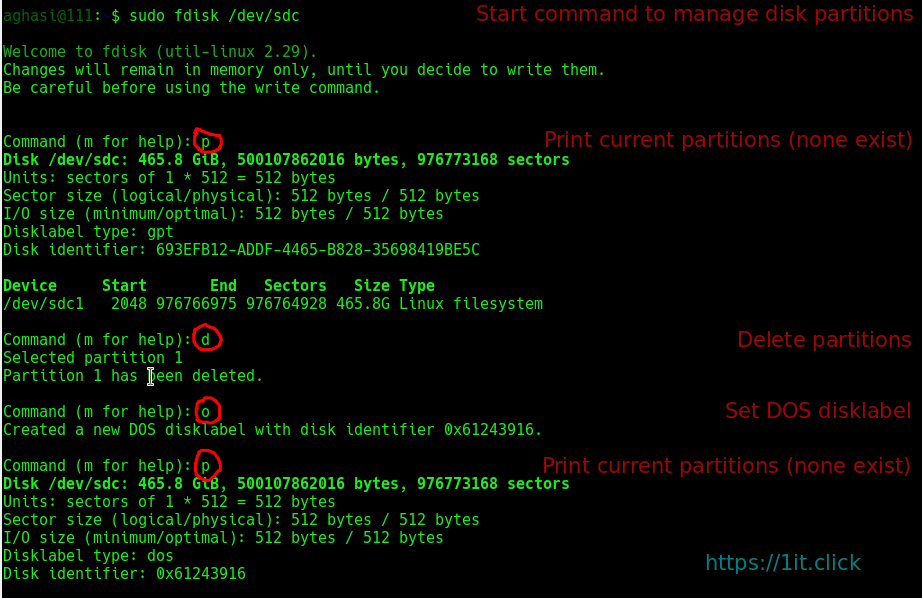
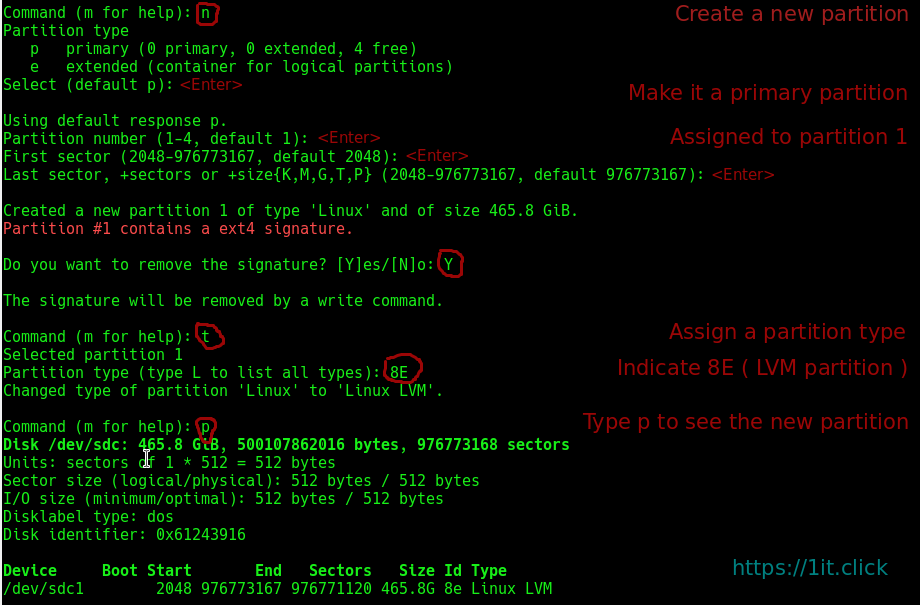
To begin, use the fdisk command to create physical partitions for the storage device on which you want to create logical partitions. Here we have an 500GB drive, located on device /dev/sdc:


Before proceeding, make sure you have made the correct changes to the correct partition! If everything looks correct, write the new partition table, as follows:

The kernel still uses the old table. The new table will be used at the next reboot or after you run partprobe(8) or kpartx(8).

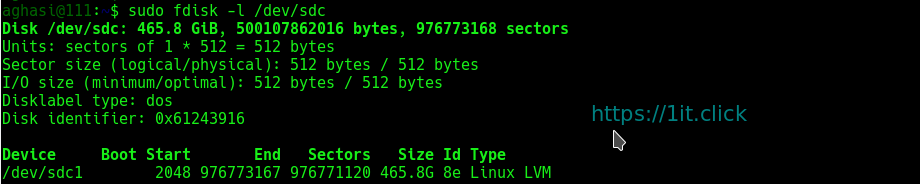
Back at the shell prompt, use the sfdisk command to see the partitioning on the drive:


or

Next, make /dev/sdc1 a new LVM physical volume and use the pvs command to view information about physical LVM volumes:

Then use vgcreate to create the vg1 volume group and list the active current volume groups:

Use lvcreate to create a new LVM partition of 1 GB from the vg1 volume group. Then use lvs to see the logical volume and vgs to see that the amount of free space has changed:

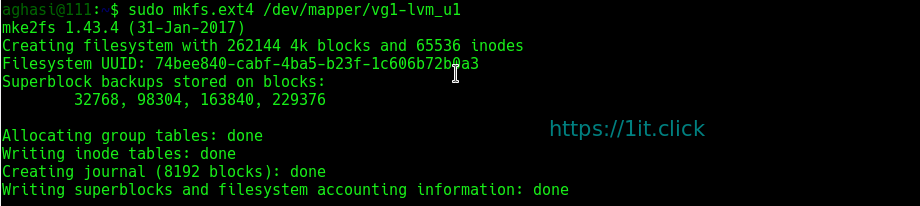
To create an ext4 filesystem on the lvm partition, use the mkfs.ext4 command as follows:

The ext4 filesystem has now been created and the LVM volume is ready to use.


Using LVM Volumes

To use the new volume just created, represented by /dev/mapper/vg1-lvm_u1, create a mount point /mnt/u1  and mount the volume. Then use df to check the available space:

At this point, the file system contains only the lost+found directory:

Copy a file to the new file system. For example, choose one of the kernel files from the /boot directory and copy it to /mnt/u1:

Run md5sum on the file you copied and save the resulting checksum for later:


Growing the LVM Volume

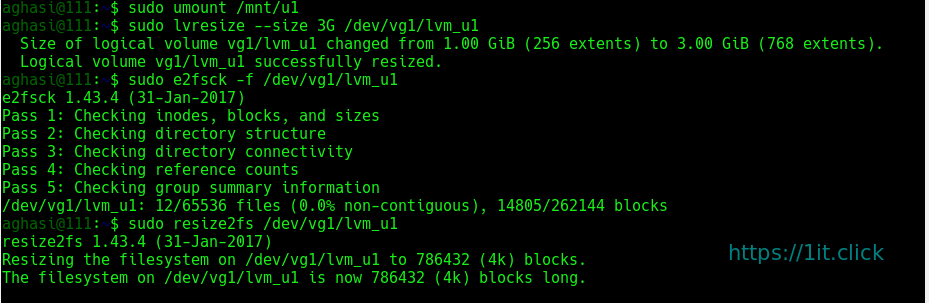
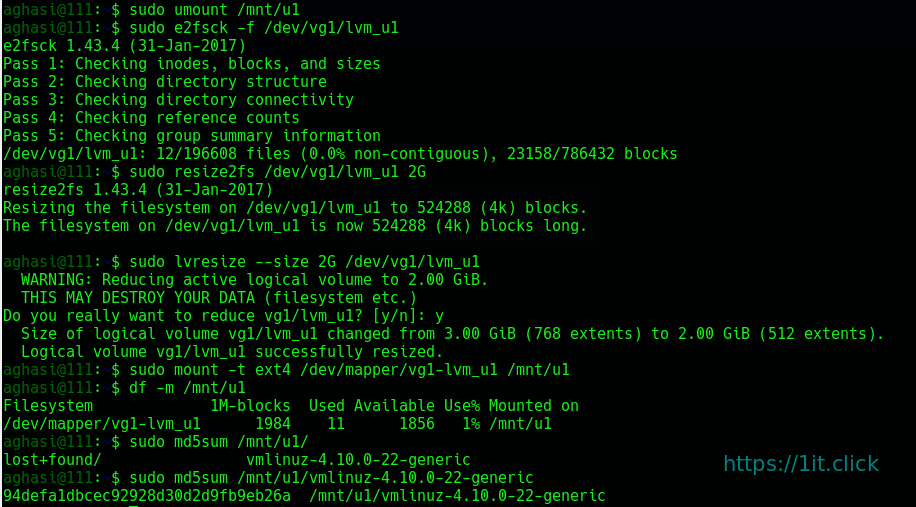
Say that you are running out of space and you want to add more space to your LVM volume. To do that, unmount the volume and use the lvresize command. ( Actually, it is not required that you unmount the volume to grow it, but it is done here as an extra precaution. )  After that, you must also check the file system with e2fsck and run resize2fs to resize the ext4 filesystem on that volume:

In the example just shown, the volume and the file system are both resized to 3 GB. Next, mount the volume again and check the disk space and the md5sum you created earlier:

The newly mounted volume is now 3 GB instead of 1 GB in size.


Shrinking an LVM Volume

You can also use the lvresize command if you want to take unneeded space from an existing LVM volume. As before, unmount the volume before resizing it and run e2fsck (to check the file system) and resize2fs (to resize it to the smaller size):

The newly mounted volume appears now as 1984 MB instead of 2992 MB in size.


Removing LVM Logical Volumes and Groups

To remove an LVM logical volume from a volume group, unmount it and then use the lvremove command as follows:

To remove an existing LVM volume group, use the vgremove command:

od Command Examples (Octal Dump)


1. Display contents of file in octal format using -b option

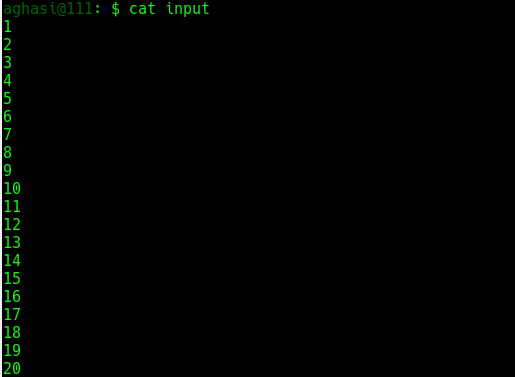
The following is the input file used for this example:

$ cat input

Now execute od command on this input file:

$ od -b input

So we see that output was produced in octal format. The first column in the output of od represents the byte offset in file.


2. Display contents of file in character format using -c option

Using the same input file:
$ od -c input

So we see that the output was produced in the character format.


3. Display the byte offsets in different formats using -A option

The byte offset can be displayed in any of the following formats :

  • Hexadecimal (using -x along with -A)
  • Octal (using -o along with -A)
  • Decimal (using -d along with -A)

The following are the examples of offsets in different formats :

$ od -Ax -c input

$ od -Ad -c input

$ od -Ao -c input

So we see that as per the input supplied to the -A option, the first column (that contains the byte offset) is displayed in different formats.


4. Display no offset information using -An option

Consider the following example:
$ od -An -c input

So we see that byte offset related information was not displayed.


5. Display output after skipping some bytes

This is achieved by using -j option:
$ od -j9 -c input

If we compare the above output with the output in example 2, we can see that initial 9 bytes were skipped from output.


6. Display limited bytes in output using -N option

This is the opposite of the -j option discussed in example 5 above:

$ od -N9 -c input

So we see that only 9 bytes were displayed in the output.


7. Display output as decimal integers using -i option

Consider the following example:
$ od -i input

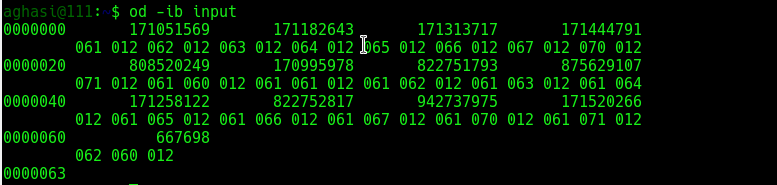
If we combine -i with -b then its gives more information as to how decimal integers are displayed:

$ od -ib input

So the above output shows how octal output is displayed as integer output.


8. Display output as hexadecimal 2 byte units using -x option

Consider the following example:
$ od -x input

So we see that the output was displayed in terms of hexadecimal 2 byte units.


9. Display the contents as two byte octal units using -o option

Consider the following example:
$ od -o input

Note that the od command displays the same output when run without any option:
$ od  input


10. Customize the output width using -d option

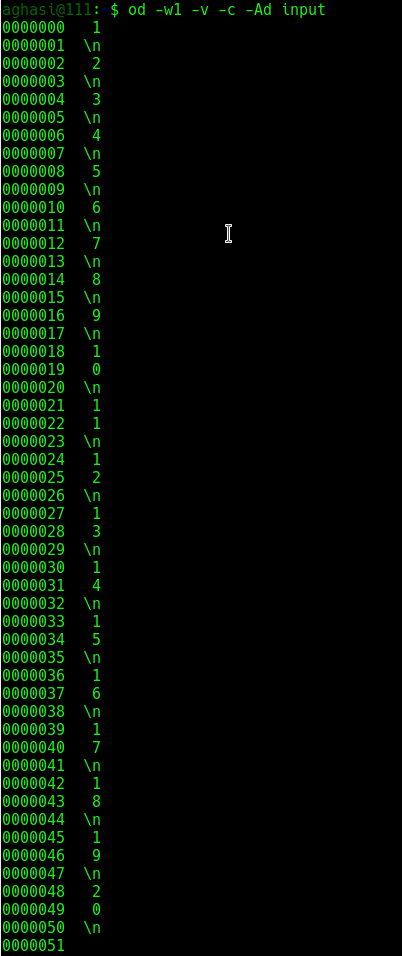
Consider the following example:
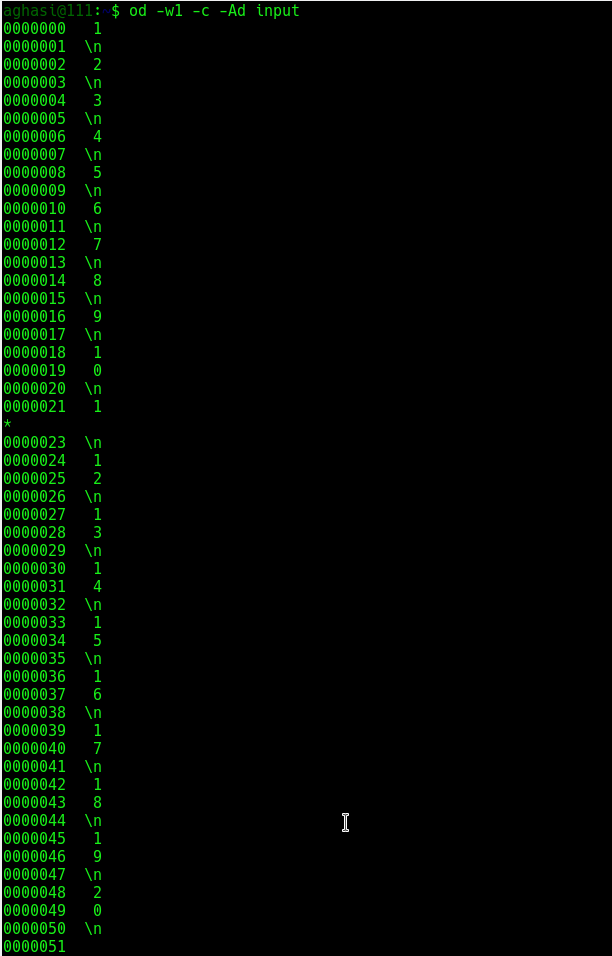
$ od -w1 -c -Ad input

So we see that output width was reduced to 1 in the above output.


11. Output duplicates using -v option

As can be observed in the output of example 10 above, a * was printed. This is done to suppress the output of lines that are same or duplicates. But through -v option these lines can also be printed:
$ od -w1 -v -c -Ad input


12. Accept input from command line using -

Consider the following example:
$ od -c -

So we see that first the input was given through stdin and then after pressing the ctrl+d a couple of times the od command output was displayed.


13. Use od on a text file

The following sample text file is used in the examples below:
$ cat input.txt

Option -b and -c are typical usages as shown below:

  • -b is same as option -t oC, select octal bytes
  • -c is same as option -t c, select ASCII characters or backslash escapes

$ od -c input.txt


$ od -bc input.txt


14. Use od on a binary file

Read the first 16 bytes and display equivalent ASCII characters or backslash:
$ od -N16 -c /usr/bin/h2xs

Read the first 16 bytes and display equivalent names characters:
$ od -N16 -a /usr/bin/h2xs

Read the first 16 bytes and display octal bytes:
$ od -N16 -bc /usr/bin/h2xs


How To Use ngrep Magical Toolkit


Introduction

ngrep strives to provide most of GNU grep‘s common features, applying them to the network layer. ngrep is a pcap-aware tool that will allow you to specify extended regular or hexadecimal expressions to match against data payloads of packets. It currently recognizes IPv4/6, TCP, UDP, ICMPv4/6, IGMP and Raw across Ethernet, PPP, SLIP, FDDI, Token Ring and null interfaces, and understands BPF (Berkeley Packet Filter)  logic in the same fashion as more common packet sniffing tools, such as tcpdump and snoop. You can print live networking packets to stdout, redirect (>) the contents to a file, or pipe (|) to another utility.


Installation

ngrep is intended to be used alongside your standard *nix command-line tooling. Thus, most package repositories are sufficiently up-to-date.

On Ubuntu use apt-get:

$ sudo apt-get install ngrep

On CentOS, use yum:

$ sudo yum install ngrep

In the following examples, it is assumed that br0 is the used network interface (unless otherwise stated).


Packet Sniffing

Monitor all interfaces and protocols for a string match of “HTTP“. The -q flag will quiet the output by printing only packet headers and relevant payloads:

$ sudo ngrep -q 'HTTP'

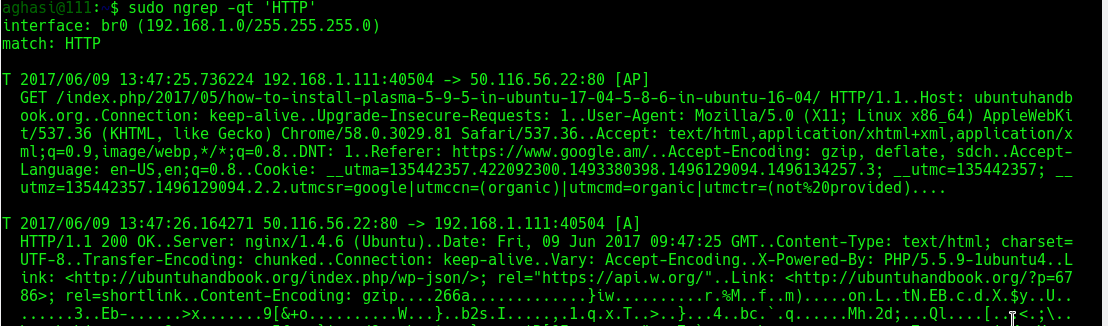
Use the -t flag to print a timestamp along with the matched information. Use -T to print the time elapsed between successive matches:

$ sudo ngrep -qt 'HTTP'

Monitor all activity crossing source or destination port 25 (SMTP):

$ sudo ngrep -d any port 25

Monitor any network-based syslog traffic for the occurrence of the word “error“. ngrep knows how to convert service port names (on Linux, located in /etc/services) to port numbers:

$ sudo ngrep -d any 'error' port syslog

Monitor any traffic crossing source or destination port 21 (FTP), looking case-insensitively for the words user or pass, matched as word-expressions (the match term(s) must have non-alphanumeric, delimiting characters surrounding them):

$ sudo ngrep -wi -d any 'user|pass' port 21

Monitor all traffic not going over port 22 (SSH):

$ sudo ngrep not port 22 | strings -n 8

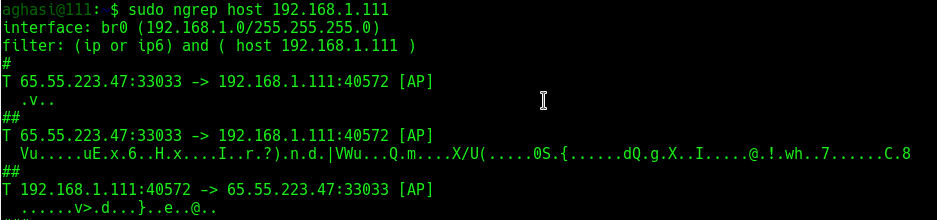
Monitor all traffic coming from a certain host:

$ sudo ngrep host 192.168.1.111

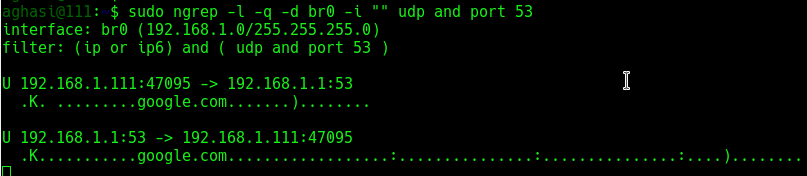
Capture network traffic incoming/outgoing to/from br0 interface and show the DNS (UDP/53) querys and responses:

$ sudo ngrep -l -q -d br0 -i "" udp and port 53

ngrep‘s syntax is similar to that of tcpdump:

$ sudo ngrep port 80 and src host 192.168.1.111 and dst host 192.168.1.1

Now let’s look for people misusing bandwidth:

$ sudo ngrep -i 'game*|chat|recipe' -W byline > bad_user.txt

To monitor current email transactions and print the addresses:

$ sudo ngrep -i 'rcpt to|mail from' tcp port smtp


Common BPF filters

The BPF specifies a rich syntax for filtering network packets based on information such as IP address. Matches all headers containing the string “HTTP” sent to or from the IP address starting with “192.168“:

$ sudo ngrep -q 'HTTP' 'host 192.168'

Will do as above, but instead match a destination host:

$ sudo ngrep -q 'HTTP' 'dst host 192.168'

Will do as above, but instead match a source host:

$ sudo ngrep -q 'HTTP' 'src host 192.168'

IP protocol:

$ sudo ngrep -q 'HTTP' 'tcp'
$ sudo ngrep -q 'HTTP' 'udp'
$ sudo ngrep -q 'HTTP' 'icmp'

Port number:

$ sudo ngrep -q 'HTTP' 'port 80'


Debugging HTTP interactions

In certain scenarios it is desirous to see how web browsers communicate with web servers, and to inspect the “HTTP” headers and possibly cookie values that they are exchanging:

$ sudo ngrep port 80

To see which files your browser is requesting any packet on the network which consists of “GET” followed by any characters but ending in “HTTP/1.0” or “HTTP/1.1“:

$ sudo ngrep -q '^GET .* HTTP/1.[01]'

Match only requests going to port 80:

$ sudo ngrep -q '^GET .* HTTP/1.[01]' 'port 80'

Match only requests going to the destination “1it.click“:

$ sudo ngrep -q '^GET .* HTTP/1.[01]' 'host 1it.click'

You can use regex such as ‘.*‘ in the search string:

$ sudo ngrep -d any "domain-.*.com" port 80

-W byline mode tells ngrep to respect embedded line feeds when they occur. You’ll note from the output above that there is still a trailing dot (.) on each line, which is the carriage-return portion of the CRLF { Carriage Return (ASCII 13, \r) Line Feed (ASCII 10, \n) } pair:

$ sudo ngrep -W byline port 80

Capture network traffic incoming/outgoing to/from br0 interface and show parameters following HTTP (TCP/80)GET or POST” methods

$ sudo ngrep -l -q -d br0 -i "^GET |^POST " tcp and port 80

Capture network traffic incoming/outgoing to/from br0 interface and show the HTTP (TCP/80)User-Agent: ” string

$ sudo ngrep -l -q -d br0 -i "User-Agent: " tcp and port 80

In the above command :
a) tcp and port 80 – is the BPF filter, that sniffs only TCP packet with port number 80
b) The -d option specifies the interface to sniff  ( br0 in this case)
c) "User-Agent: " is the string to search for all packets that have that string are displayed

Monitor specific traffic:

$ sudo ngrep -t '^(GET|POST|HEAD) ' 'dst host 216.58.210.14 and tcp and dst port 80'

Then send a header request to a specific URL:

$ curl -I google.com

Or, break the response by newlines:

$ sudo ngrep -t '^(GET|POST|HEAD) ' 'dst host 216.58.210.14 and tcp and dst port 80' -W byline


Processing PCAP dump files, looking for patterns

Timestamp all traffic on port 53 (DNS) on all devices (if the box has multiple devices) and send the output to a pcap file specified by the -O switch:

$ sudo ngrep -O /tmp/dns.dump -d any -T port domain

Now we have a PCAP dump file, and so let’s search for the letter ‘m‘ for some patterns:

$ sudo ngrep -w 'm' -I /tmp/dns.dump

Here we’ve added -t which means print the absolute timestamp on the packet, and -D which means replay the packets by the time interval at which they were recorded. The latter is a neat little feature for observing the traffic at the rates/times they originally seen, though in this example it’s not terribly effective as there is only one packet being matched.

$ sudo ngrep -tD ns3 -I /tmp/dns.dump
$ sudo ngrep -I /tmp/dns.dump port 80

There’s no port 80 traffic in the dump, so of course the BPF filter yields us no results.


Debugging MySQL

Show the query and results of SELECT queries going to your MySQL server:

$ sudo ngrep -d br0 -i 'select' port 3306

Show the query and results of all queries going to your MySQL server:

If the following MySQL query returns the following:

$ sudo mysql -h 127.0.0.1 -B -e 'select * from user;' mysql

Watch the traffic:

# sudo ngrep -d lo -wi "" port 3306